SBI Clerk Admit Card 2026 Out (Regular), Download Pre Call Letter @sbi.co.in

Candidates appearing for the SBI Clerk exam can now access their call letters for the upcoming preliminary examination. The admit card contains important details related to the exam, including the candidate’s centre, date and shift. The SBI Clerk Prelims 2026 will be conducted on 26 and 27 September 2026 for candidates shortlisted to appear in the examination under Advertisement No. CRPD/CR/2026-27/17, against 9,766 Junior Associate vacancies.

SBI Clerk Prelims Admit Card 2026 Out

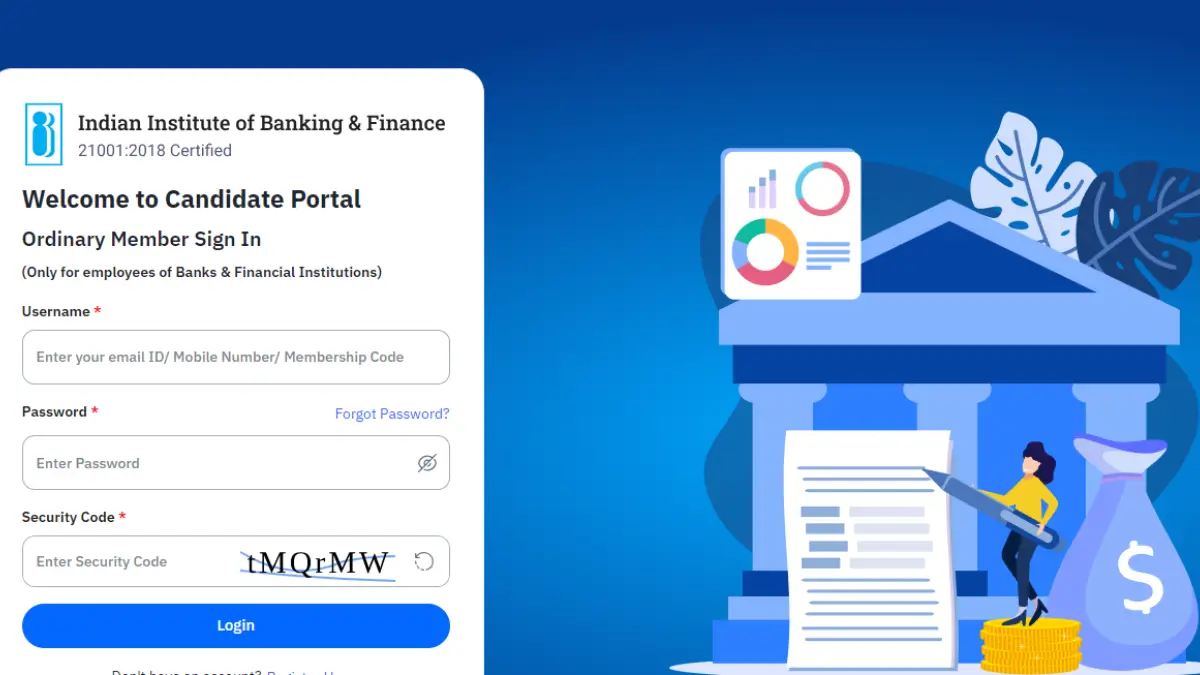
Before heading to the examination centre, candidates should verify their allotted schedule and venue details from the SBI Clerk Prelims call letter. The document also provides instructions that candidates must follow on the day of the examination. Access to the call letter is provided through the SBI recruitment portal, where applicants can log in with their Registration Number/Roll Number along with their Password or Date of Birth.

SBI Clerk Admit Card 2026: Overview

The SBI Clerk Prelims 2026 exam is scheduled to be conducted in 4 shifts in a day across various exam centres. The key details regarding the SBI Clerk Admit Card 2026 are provided below:

Particulars Details
Conducting Body State Bank of India
Exam Name SBI Clerk 2026
Post Junior Associate (Customer Support & Sales)
Advertisement No. CRPD/CR/2026-27/17
Total Vacancies 9,766
Total Applicants 13,01,360+ candidates
Admit Card Status Released
Admit Card Release Date 21 September 2026
Prelims Exam Date 26 & 27 September 2026
Exam Mode Online
Selection Process Prelims, Mains & LPT
Official Website sbi.co.in

SBI Clerk Admit Card Download Link

Candidates can download the SBI Clerk Admit Card through the official link we have provided below. The login page requires candidates to provide the prescribed credentials before the admit card is displayed. After downloading the document, candidates should save the PDF and take a clear printout for use at the examination center.

How to Download the SBI Clerk Call Letter 2026 PDF from sbi.co.in?

Candidates can download their SBI Clerk Prelims Admit Card 2026-27 online using their registration details. The call letter can be accessed by following these steps:

  • Go to the official SBI Careers portal.
  • Navigate to the Current Openings section.
  • Find the RECRUITMENT OF JUNIOR ASSOCIATES (CUSTOMER SUPPORT & SALES) Advt No. CRPD/CR/2026-27/17 recruitment.
  • Select the link for the Preliminary Examination Call Letter.
  • Enter your Registration Number/Roll Number.
  • Provide your Password or Date of Birth.
  • Enter the displayed captcha and proceed.
  • Check the details shown on the screen and open the call letter.
  • Download the admit card and take a printout for the examination day.

SBI Clerk Prelims Information Handout 2026 Pdf

The SBI Clerk Prelims Information Handout 2026 contains important exam-related guidelines that candidates should read before appearing for the test. It generally covers:

  • Exam pattern and section-wise time details
  • Instructions for reaching and entering the exam centre
  • Documents required for verification
  • Rules regarding permitted and prohibited items
  • Important instructions to be followed inside the examination hall
  • Guidelines for candidates with specific requirements or assistance
  • General exam-day instructions and precautions

Credentials Required to Download SBI JA Pre Admit Card 2026

Candidates should keep their application details ready before proceeding with the admit card download. The following credentials may be required:

  • Registration Number: The number generated after successful submission of the application.
  • Date of Birth: Enter the date of birth registered in the application.
  • CAPTCHA: Enter the characters displayed in the CAPTCHA box.
  • Text Verification: Complete the verification shown on the login page.

Information Available on SBI Clerk Regular Admit Card 2026

The call letter serves as the candidate’s examination document and carries several exam-specific details. Candidates should particularly check:

  • Candidate’s roll number and registration details
  • Allocated examination date and shift
  • Reporting time and other timing-related instructions
  • Name and complete address of the test center
  • Candidate’s photograph and other identification details
  • Guidelines to be followed inside the examination venue

What to Do If There Is an Error in the Call Letter?

After downloading the SBI Junior Associate Admit Card, candidates should carefully check all personal and examination-related information. If they find any incorrect or unclear details, they should take the following steps:

  • Check the application details: Compare the information on the call letter with the details submitted during registration.
  • Do not make manual changes: Candidates should not alter or overwrite any information printed on the admit card.
  • Contact SBI promptly: Report any significant discrepancy through the official SBI recruitment support channel.
  • Keep proof ready: Candidates should retain their application details and a copy of the admit card while raising the issue.
  • Follow SBI’s instructions: Any correction or clarification should be handled only through the official process communicated by SBI.
  • Do not ignore major errors: Issues involving the candidate’s name, roll number, photograph, exam date, shift, or examination center should be reported without delay.

SBI Clerk Prelims Shift Timings 2026

The SBI Clerk Prelims Examination is conducted in four shifts. Candidates must follow the reporting time mentioned on their individual admit card, as entry procedures begin before the actual examination starts. The commonly reported shift schedule is as follows:

Shift Reporting Time Exam Time
Shift 1 8:00 AM 9:00 AM – 10:00 AM
Shift 2 10:30 AM 11:30 AM – 12:30 PM
Shift 3 1:00 PM 2:00 PM – 3:00 PM
Shift 4 3:30 PM 4:30 PM – 5:30 PM

SBI Clerk Prelims Exam Pattern 2026

The SBI Clerk Prelims exam consists of 100 questions for 100 marks, to be completed in 60 minutes. Each section has a separate 20-minute time limit.

  • English Language: 30 Questions | 30 Marks | 20 Minutes
  • Numerical Ability: 35 Questions | 35 Marks | 20 Minutes
  • Reasoning Ability: 35 Questions | 35 Marks | 20 Minutes

Key Points:

  • Online examination mode
  • 60 minutes total duration
  • 20 minutes fixed for each section
  • 1/4th mark deducted for every incorrect answer
  • English section is conducted in English; other sections follow the prescribed language options.

SBI Clerk Qualifying Marks and Cut-off Rules

SBI does not prescribe separate qualifying marks for each section of the clerk examination. Candidates are considered on the basis of their aggregate marks, with the applicable cut-off decided as per the recruitment requirements. The main rules are:

  • No sectional cut-off: Candidates are not required to secure separate minimum marks in Reasoning, Numerical Ability, or English.
  • State/UT-wise cut-off: The overall cut-off is determined separately for different states/UTs and categories.
  • Prelims shortlisting: Candidates up to around 10 times the number of vacancies are shortlisted for the Mains examination based on the aggregate score.
  • Mains merit: The Mains examination score is considered for final merit, subject to fulfilling the applicable Local Language Proficiency Test (LPT) requirement.
  • Category-wise criteria: SBI may prescribe minimum qualifying marks for reserved categories as specified in the recruitment process.

SBI Clerk Selection Process

Candidates who qualify for the required stages are considered for final selection as junior associates. The SBI Clerk recruitment process is completed through the following stages:

  • Prelims Exam: The preliminary examination is the first stage and is conducted to shortlist candidates for the Mains examination.
  • Mains Exam: Candidates who qualify in the Prelims appear for the Mains examination, which plays an important role in the selection process.
  • Local Language Proficiency Test (LPT): Candidates are required to demonstrate proficiency in the specified local language of the state/UT for which they have applied.

Prohibited Items at Exam Center

Candidates should avoid carrying items that are not permitted inside the SBI Clerk examination hall. The exact restrictions should be checked on the admit card and official instructions.

  • Mobile phones and other electronic devices
  • Smartwatches, Bluetooth devices, or headphones
  • Calculators and electronic gadgets
  • Bags or unnecessary personal belongings
  • Any other item specifically prohibited by SBI

SBI Clerk Prelims Exam Day Instructions

Candidates should reach the examination centre well before the reporting time and follow the instructions given on the admit card.

  • Carry a printed copy of the admit card.
  • Bring valid photo ID proof as specified.
  • Check the examination center and route in advance.
  • Follow the instructions given by the exam staff.
  • Do not carry prohibited items inside the examination hall.
  • Follow the allotted shift and reporting time mentioned on the call letter.

Things to Verify Before Leaving for the SBI Clerk Prelims Exam

Before leaving for the examination center, candidates should review their SBI Clerk Pre Admit Card 2026 once to avoid last-minute confusion. The following details should be checked carefully:

  • Exam Date & Shift: Confirm the date and shift allotted to you.
  • Reporting Time: Reach the center well before the reporting time mentioned on the call letter.
  • Exam Center Address: Check the complete venue address and plan your route in advance.
  • Roll Number: Ensure your roll number is clearly visible and matches your exam details.
  • Candidate Details: Verify your name, photograph, and other personal information.
  • Exam Instructions: Read the instructions printed on the call letter, especially those related to permitted and prohibited items.
  • Required Documents: Keep the printed admit card and valid photo ID ready as specified in the call letter.

SBI Clerk Prelims Important Topics: What Should Candidates Focus On?

The SBI Clerk Prelims paper covers Reasoning Ability, Numerical Ability and English Language. Although the topic-wise weightage may vary across shifts, candidates should focus on areas that are commonly asked and require regular practice.

Section Important Topics
Reasoning Ability Puzzles & Seating Arrangement, Syllogism, Inequality, Blood Relation, Coding-Decoding, Series
Numerical Ability Simplification, Number Series, Data Interpretation, Arithmetic, Quadratic Equations
English Language Reading Comprehension, Cloze Test, Error Detection, Fillers, Para Jumbles, Word Swap

Key focus areas:

  • Practise Puzzles, Simplification, Arithmetic and Reading Comprehension regularly.
  • Revise Syllogism, Inequality, Number Series, DI and Error Detection.
  • Take sectional tests to improve speed, accuracy and question selection.

SBI Clerk Prelims 2026: Do’s and Don’ts for Exam Day

Candidates should follow the instructions mentioned on the SBI Clerk Prelims Admit Card and reach the examination centre as per the reporting time. A few important do’s and don’ts can help candidates avoid last-minute issues on exam day.

Do’s

  • Carry the admit card: Bring a clear printed copy of the SBI Clerk Prelims call letter.
  • Carry valid ID proof: Keep the required original photo identity proof ready as mentioned in the instructions.
  • Reach early: Visit the exam centre well before the reporting time to complete the entry process comfortably.
  • Check the venue: Verify the exam centre address and plan the route in advance.
  • Follow instructions: Carefully follow the directions given by the exam staff and on the call letter.
  • Keep essentials ready: Arrange all required documents a day before the examination.

Don’ts

  • Do not carry electronic gadgets: Avoid mobile phones, smartwatches, Bluetooth devices, calculators and other prohibited items.
  • Do not carry unnecessary belongings: Bags and other items not allowed at the centre should be avoided.
  • Do not arrive late: Candidates should follow the reporting and entry timings mentioned on their call letter.
  • Do not alter the admit card: Avoid making any handwritten changes or corrections on the printed call letter.
  • Do not ignore exam instructions: Read all guidelines carefully before entering the examination hall.
  • Do not panic: Stay calm and manage the sectional time carefully during the examination.

SBI Clerk 2026 Exam Centres

State/UT Exam Centres
Andhra Pradesh Amaravati, Guntur, Kurnool, Vijayawada, Visakhapatnam
Assam Dibrugarh, Guwahati, Jorhat, Silchar
Bihar Arrah, Aurangabad, Bhagalpur, Patna, Muzaffarpur
Delhi Delhi/NCR
Gujarat Ahmedabad, Anand, Gandhinagar, Rajkot, Surat, Vadodara
Haryana Ambala, Gurugram, Hisar, Karnal, Kurukshetra
Himachal Pradesh Bilaspur, Hamirpur, Kangra, Kullu, Shimla
Jammu & Kashmir Jammu, Srinagar
Jharkhand Bokaro, Dhanbad, Jamshedpur, Ranchi
Karnataka Bengaluru, Belgaum, Mangalore, Mysore, Shimoga
Kerala Ernakulam, Kannur, Kollam, Kottayam, Kozhikode, Thiruvananthapuram
Madhya Pradesh Bhopal, Gwalior, Indore, Jabalpur, Sagar
Maharashtra Aurangabad, Mumbai/Navi Mumbai/Thane, Nagpur, Nashik, Pune
Odisha Bhubaneswar, Cuttack, Rourkela, Sambalpur
Punjab Amritsar, Bhatinda, Jalandhar, Ludhiana, Mohali, Patiala
Rajasthan Ajmer, Jaipur, Jodhpur, Kota, Udaipur
Tamil Nadu Chennai, Coimbatore, Madurai, Salem, Tiruchirappalli
Telangana Hyderabad, Karimnagar, Warangal
Uttar Pradesh Agra, Allahabad/Prayagraj, Bareilly, Ghaziabad, Kanpur, Lucknow, Meerut, Varanasi
Uttarakhand Dehradun, Haldwani, Roorkee
West Bengal Asansol, Durgapur, Kolkata, Siliguri

Daily Current Affairs Quiz 23rd September, 2026 for Banking & Competitive Exams

Daily Current Affairs: 23 September 2026

Q1. Indian women defeated which team in the final to win its first-ever gold medal in women’s cricket at the Asian Games 2026?

(a) Afghanistan

(b) Pakistan

(c) Bangladesh

(d) Sri Lanka

(e) Nepal

Answer: d

Solution:

  • India defeated Sri Lanka by 147 runs in the final to win its first-ever gold medal in women’s cricket at the Asian Games 2026.
  • India posted 216/3 in 20 overs, with Smriti Mandhana scoring 79 runs and Richa Ghosh remaining unbeaten on 49.
  • Sri Lanka were bowled out for 69 runs in 15.4 overs.

Q2. Smriti Mandhana scripted history by becoming the first cricketer in the world to reach 11,000 international runs in women’s cricket during the Asian Games 2026 final. Whom did she surpass to achieve this record?

(a) Meg Lanning

(b) Suzie Bates

(c) Mithali Raj

(d) Charlotte Edwards

(e) Ellyse Perry

Answer: c

Solution:

  • Smriti Mandhana became the first cricketer in the world to score 11,000 runs in women’s international cricket.
  • She achieved the milestone during the Asian Games 2026 final against Sri Lanka.
  • Mandhana surpassed the previous record held by former Indian captain Mithali Raj, who had scored 10,868 runs.

Q3. Union Home Minister Amit Shah inaugurated the 3rd National Conference of Anti-Narcotics Task Force (ANTF) Heads in New Delhi on 22 September 2026. What is the official theme of this conference?

(a) Nasha Mukt Bharat: Shared Vision

(b) United Resolve, Shared Responsibility

(c) Zero Tolerance Against Drugs

(d) Strengthening Law Enforcement & Youth Protection

(e) Narcotics Free India 2047

Answer: b

Solution:

  • Union Home Minister Amit Shah inaugurated the 3rd National Conference of Anti-Narcotics Task Force (ANTF) Heads of States and Union Territories in New Delhi on 22 September 2026.
  • The two-day conference is being organised by the Narcotics Control Bureau (NCB).
  • Heads of ANTFs from 36 States and Union Territories are participating.
  • Theme: “United Resolve, Shared Responsibility.”
  • The conference focuses on the progress of targets assigned to State and UT ANTFs under the Vision Document on Narcotics Control (2026–29).

Q4. According to the provisional estimates released for August 2026, the Index of Core Industries (ICI) registered a year-on-year growth rate of 4.8 per cent. Which of the following sectors recorded a negative growth rate during August 2026?

(a) Cement

(b) Steel

(c) Coal

(d) Iron Ore

(e) Electricity

Answer: c

Solution:

The Index of Core Industries (ICI) grew by 4.8% year-on-year in August 2026, according to provisional estimates.

This was slightly lower than the 5.0% growth recorded in July 2026.

Cement (12.5%), Electricity (11.6%), Iron Ore (5.5%), Steel (3.4%) and Refinery Products (2.6%) recorded positive growth.

Coal, Natural Gas, Crude Oil and Fertilizers recorded negative growth.

Iron Ore, Electricity and Cement were major contributors to overall ICI growth.

The cumulative growth of the ICI during April–August 2026 stood at 4.3%, compared with 2.4% during the corresponding period of the previous year.

Q5. The 18th edition of the annual Joint Military Exercise NOMADIC ELEPHANT (September 21 – October 03, 2026) is being conducted between India and which country at Pithoragarh, Uttarakhand?

(a) Kazakhstan

(b) Mongolia

(c) Kyrgyzstan

(d) Uzbekistan

(e) Tajikistan

Answer: b

Solution:

  • The 18th edition of India–Mongolia Joint Military Exercise NOMADIC ELEPHANT commenced at the Foreign Training Node, Pithoragarh, Uttarakhand.
  • The exercise is being conducted from 21 September to 3 October 2026.
  • It is an annual platoon-level exercise conducted alternately between India and Mongolia.
  • The Indian Army and Mongolian Armed Forces are participating with 45 personnel each.
  • The exercise aims to enhance joint capabilities for counter-insurgency operations in semi-urban and mountainous terrain under a United Nations mandate.
  • The previous edition was held in Ulaanbaatar, Mongolia, in May–June 2025.

 Q6. The 9th edition of India’s flagship water event (organized by the Ministry of Jal Shakti from 22–26 September 2026) was rebranded as India International Water Week (IIWW) 2026. What was the central theme for the 2026 event?

(a) Water Security for Sustainable Growth

(b) Valuing Water: Global Perspectives

(c) Climate Resilient Water Management

(d) Integrated Water Resources Management

(e) Clean Water, Healthy Ecosystems

Answer: c

Solution:

  • Vice President P. Radhakrishnan inaugurated the 9th India International Water Week (IIWW) 2026 in New Delhi on 22 September 2026.
  • The event is being organised by the Ministry of Jal Shakti from 22–26 September 2026.
  • Theme: “Climate Resilient Water Management.”
  • The event provides a multidisciplinary platform for policymakers, water experts, researchers, industry, civil society and young professionals to discuss emerging water challenges.
  • The event was originally conceptualised in 2012 as India Water Week (IWW).
  • Eight editions of India Water Week were organised between 2012 and 2024.
  • It will now be organised as India International Water Week (IIWW).

 Q7. World Rhino Day is observed globally on September 22 to raise awareness about the conservation of the five remaining rhinoceros species. In which year was World Rhino Day first announced by WWF-South Africa before expanding into an international observance?

(a) 2008

(b) 2010

(c) 2011

(d) 2014

(e) 2016

Answer: b

Solution:

World Rhino Day is observed annually on 22 September to raise awareness about rhinoceros conservation.

Theme 2026: “Keep the Five Alive.”

The theme calls for stronger efforts to protect rhino habitats, prevent poaching and combat the illegal trade in rhino horn.

Around 27,000 rhinos remain in the wild, compared with nearly 5 lakh a century ago.

India and Nepal together are home to nearly 4,000 greater one-horned rhinoceros.

World Rhino Day was first announced by WWF-South Africa in 2010 and developed into an international observance in 2011.

Q8. India’s first indigenous Long-Range One-Way Attack (OWA) drone successfully completed its flight tests at the Pokhran Field Firing Range in September 2026. What is the name of this drone platform developed by IG Defence?

(a) NAGASTRA

(b) Surya

(c) TAPAS

(d) ABHYAS

(e) KAL

Answer: e

Solution:

  • India’s first indigenous Long-Range One-Way Attack (OWA) drone, named ‘KAL’, successfully completed flight testing in September 2026.
  • The trials were conducted at the Pokhran Field Firing Range (PFFR), Rajasthan.
  • The drone was designed and developed by IG Defence, Noida, Uttar Pradesh.
  • The trials validated its airframe, propulsion, avionics, navigation and mission systems.
  • The drone was launched from a vehicle-mounted platform.

 Q9. Until when have the Indian Space Research Organisation (ISRO) and the European Space Agency (ESA) extended their bilateral Cooperative Agreement?

(a) 31 December 2030

(b) 8 January 2032

(c) 15 August 2035

(d) 10 September 2028

(e) 26 January 2030

Answer: b

Solution:

  • ISRO and the European Space Agency (ESA) have extended their Cooperative Agreement until 8 January 2032.
  • The extension was formalised through an exchange of letters in Paris on 10 September 2026 during the International Space Summit.
  • The original agreement came into force in January 2002.
  • The renewed cooperation covers human and robotic exploration, space weather and sustainable outer-space activities.
  • ISRO Chairman V. Narayanan and ESA Director General Josef Aschbacher signed the extension documents.

 Q10. According to the State of Global Water Resources 2025 report released by the World Meteorological Organization (WMO), approximately what estimated ice mass was lost across major glaciated regions during the 2025 hydrological year?

(a) 150 gigatonnes

(b) 250 gigatonnes

(c) 408 gigatonnes

(d) 620 gigatonnes

(e) 800 gigatonnes

Answer: c

Solution:

The World Meteorological Organization (WMO) released the State of Global Water Resources 2025 report, highlighting persistent changes in global water availability.

42% of the global land area experienced below-normal water storage in 2025.

Global terrestrial water storage has shown a declining trend since 2014–16.

For the fourth consecutive year, all major glaciated regions recorded ice-mass losses.

Global glacier loss during the 2025 hydrological year was estimated at around 408 gigatonnes, equivalent to approximately 1 mm of global sea-level rise.

2025 was among the driest years for global rivers in 35 years, with normal flows recorded across only 36% of global river-basin area.

Persistent groundwater deficits during 2022–25 were reported in parts of the Americas, Europe, the Middle East, India, southern Africa and Australia.

In India, below-normal terrestrial water storage was recorded in 2025, particularly in the northern region.

The Ganges, Godavari, Krishna and Indus recorded above-normal to much-above-normal discharge in 2025.

Despite higher river flows, India continued to experience persistent groundwater deficits during 2022–25, particularly in northwestern India.

Prepare These 5 Topics to Score 30+ Marks in Numerical Ability for SBI Clerk Prelims

With the SBI Clerk Prelims 2026 scheduled for 26 and 27 September, candidates should now focus on topics that can deliver maximum returns through regular practice. Numerical Ability carries 35 questions, and smart topic selection can help candidates improve both speed and accuracy. Instead of trying to revise the entire syllabus at the last moment, aspirants should prioritise the most manageable and frequently practised areas.

Prepare These 5 Topics to Score 30+ Marks in Numerical Ability for SBI Clerk Prelims

The Numerical Ability section in the SBI Clerk 2026 Prelims exam is important as it can help boost your overall score. To score 30+ marks in this section, identifying and practicing the right topics are essential. Below are five important topics that can help you achieve a high score.

Also Check, SBI Clerk Admit Card 2026

1. Simplification and Approximation

This topic is the easiest to score and helps in quick calculations. Questions are based on basic mathematical operations like addition, subtraction, multiplication, and division. Learning shortcut methods such as the BODMAS rule, squares, cubes, and percentage tricks will help you solve these questions faster.

2. Number Series

In this topic, you will get a series of numbers with a missing term. You need to find the pattern and complete the series. The patterns can be based on addition, subtraction, multiplication, division, squares, cubes, or prime numbers. Regular practice can help you identify these patterns quickly and solve the questions within seconds.

3. Data Interpretation

Data Interpretation (DI) questions are based on tables, bar graphs, line graphs, and pie charts. You will have to analyze the given data and answer questions related to percentages, averages, and ratios. Strengthening basic mathematical concepts like percentage calculations and ratios will make solving DI questions easier and quicker.

4. Arithmetic 

Arithmetic covers various topics such as percentages, profit and loss, simple and compound interest, time and work, time and distance, partnership, and mixtures. These questions test your ability to apply mathematical concepts in real life situations. Understanding the formulas and practicing different types of problems will help in scoring well in this section.

5. Quadratic Equations

Quadratic equation questions require solving for the values of x and y. The most common type of question asks you to compare two quadratic equations and determine which value is greater or if they are equal. Learning factorization and using the quadratic formula can help solve these problems quickly and accurately.

SBI Clerk Numerical Ability Syllabus

Below are the important topics in Numerical Ability that are most relevant for the SBI Clerk exam based on the syllabus.

  • Simplification and Approximation
  • Basic Calculation
  • Quadratic Equation
  • Time & Work
  • Speed Time & Distance
  • Simple Interest & Compound Interest
  • Data Interpretation
  • Number Series
  • Arithmetic Problems
  • Problems on L.C.M and H.C.F
  • Quadratic Equations
  • Probability
  • Profit and Loss

30+ Marks Question Selection Strategy

Area Target Approach
Simplification/Approximation
Attempt quickly if calculations are manageable
Number Series
Skip unusual patterns after a reasonable time
Quadratic Equations Prioritise if equations are straightforward
DI Attempt easy sets first
Arithmetic
Select familiar concepts before lengthy questions

Tips To Score 30+ Marks in Numerical Ability Section of SBI Clerk

Try to inculcate them in your preparation to maximize your scores.

  • Try to maintain speed and accuracy both to avoid negative marking.
  • Keep on Practicing Mock Tests and Previous Year Questions.
  • Revise basic mathematical formulae and concepts daily.
  • Learn Shortcut techniques and tricks for faster calculations.
Related Posts
3 Important Quant Hacks to Increase Calculation Speed for SBI Clerk Exam
Simplification Questions Asked in Last 4 Years in SBI Clerk Exam
Who Can Skip the SBI Clerk Language Test?
Seating Arrangement Questions for SBI Clerk
SBI Clerk Cut Off SBI Clerk Syllabus
SBI Clerk Preparation SBI Clerk Previous Year Question Paper
SBI Clerk Salary SBI Clerk Mock Test

Daily Current Affairs and GK Updates (22nd September, 2026)

Important Days

1. World Rhino Day 2026

  • World Rhino Day: 22 September.
  • Theme 2026: “Keep the Five Alive.”
  • First announced by WWF-South Africa in 2010; international observance began in 2011.
  • Number of surviving rhino species: 5.
  • Estimated global rhino population: ~26,700.
  • Greater One-Horned Rhino: ~4,075; mainly found in India and Nepal.
  • Scientific name: Rhinoceros unicornis; IUCN Status: Vulnerable.
  • Major Indian stronghold: Assam, particularly Kaziranga National Park.

2. 11th Ayurveda Day 2026

  • 11th Ayurveda Day: 23 September 2026.
  • Theme: “Ayurveda for a Healthier Tomorrow.”
  • Nodal Ministry: Ministry of Ayush.
  • 12,260 Ayushman Arogya Mandirs (Ayush) functional against a target of 12,500.
  • India has 593 Ayurveda colleges.
  • AYURGYAN Scheme: Launched in 2021-22.
  • India has 46 Ayush Information Cells in 43 countries.
  • Union Budget 2026-27 allocated ₹4,408 crore to the Ministry of Ayush and announced 3 new All India Institutes of Ayurveda.
  • WHO Global Traditional Medicine Centre: Jamnagar, Gujarat.

National News

3. President Amends Inter-State Council Order, 1990

  • President Droupadi Murmu amended the Inter-State Council Order, 1990.
  • Inter-State Council (Amendment) Order, 2026 issued on 9 September 2026.
  • Inter-State Council is constituted under Article 263 of the Constitution.
  • Governor can attend during President’s Rule under Article 356.
  • Delhi LG: Article 239AB.
  • Puducherry: Section 51, Government of Union Territories Act, 1963.
  • Jammu & Kashmir: Section 73, J&K Reorganisation Act, 2019.
  • Original Inter-State Council Order issued on 28 May 1990.

4. Digital Communications Commission Dissolved

  • Government dissolved the Digital Communications Commission (DCC) after nearly 37 years.
  • Parent department: Department of Telecommunications (DoT).
  • Established as Telecom Commission in April 1989.
  • Renamed DCC in October 2018 after the National Digital Communications Policy, 2018.
  • Cabinet approved dissolution on 16 September 2026.
  • Government resolution issued on 19 September 2026.
  • DCC’s final meeting: 3 September 2026.
  • Its functions will now move more directly through the Telecom Secretary.

5. 7th National Formulary of India 2026 Launched

  • 7th National Formulary of India (NFI) launched on 21 September 2026.
  • Venue: Dr. Ambedkar International Centre, New Delhi.
  • Launched by Anupriya Patel.
  • Published by the Indian Pharmacopoeia Commission (IPC).
  • NFI promotes rational and safe use of medicines.
  • Previous 6th edition was launched in October 2021.
  • 6th National Pharmacovigilance Week: 17–23 September 2026.
  • Theme: “Promoting Rational Use of Medicines through Pharmacovigilance: A Step Towards Safer Healthcare.”

Appointments News

6. Jayanti Prasad Gets Additional Charge as IBBI Chairperson

  • Jayanti Prasad given additional charge as Chairperson of IBBI.
  • Existing position: Whole-Time Member, IBBI.
  • Effective from: 13 September 2026.
  • Predecessor: Ravi Mital.
  • His current IBBI tenure ends on 20 November 2026.
  • IBBI: Insolvency and Bankruptcy Board of India.
  • IBBI is the key regulator under the Insolvency and Bankruptcy Code (IBC), 2016.

Banking & Economy News

7. RBI Issues Basel III Market Risk Directions 2026

  • RBI issued Commercial Banks – Minimum Capital Requirements for Market Risk Directions, 2026.
  • Effective from 1 April 2027.
  • Framework aligned with revised Basel III standards.
  • Method adopted: Simplified Standardised Approach (SSA).
  • Draft guidelines were issued on 17 February 2023.
  • Transition scalars have been applicable since 1 April 2024.
  • Trading book linked to Held for Trading (HFT) classification.
  • Revised treatment covers debt mutual funds, ETFs and Total Return Swaps (TRS).
  • BCBS: Basel Committee on Banking Supervision.

8. Sagarmala Finance to Issue India’s Maiden Blue Bond

  • Issuer: Sagarmala Finance Corporation.
  • India’s maiden blue bond issue scheduled for 28 September 2026.
  • Planned amount: ₹600 crore.
  • Greenshoe option: ₹500 crore.
  • Maturity: 10 years.
  • Rating: AA+ by ICRA and CARE.
  • Arranger: SBI Capital Markets.
  • Proceeds will finance maritime projects, greenfield ports and coastal roads.

9. ONGC Makes Gas Discovery in Mahanadi Offshore Basin

  • ONGC discovered gas in the Mahanadi Offshore Basin, Odisha.
  • Well: MN-DW18-1-H-D.
  • Discovery announced: 18 September 2026.
  • Target depth: 1,623 metres.
  • Gas-bearing interval: 1,441–1,452 metres.
  • Located approximately 43 km from the Konark coast.
  • It is ONGC’s first well-based discovery under the Samudra Manthan programme.
  • Samudra Manthan: ₹84,000-crore offshore exploration initiative launched in July 2026.

Business & Corporate News

10. Starbucks to Establish First India GCC in Chennai

  • Starbucks Coffee will establish its first Global Capability Centre (GCC) in India.
  • Location: Chennai, Tamil Nadu.
  • MoU signed with Guidance Tamil Nadu.
  • Expected employment: Around 800 jobs in the first phase.
  • Starbucks CTO: Anand Varadarajan.
  • Indian retail partner: Tata Consumer Products.
  • The new GCC will operate separately from the Starbucks-Tata retail joint venture.

International News

11. India Co-Sponsors Inaugural P4M Summit

  • India co-sponsored the inaugural P4M Summit.
  • P4M: Partners for Multilateralism, International Law, Peace and Prosperity.
  • Held on 21 September 2026 in New York.
  • Held on the sidelines of the 81st UN General Assembly.
  • India represented by External Affairs Minister S. Jaishankar.
  • Initial co-sponsors: Australia, Barbados, Brazil, Canada, European Union, India and Kenya.
  • Jaishankar called for reformed multilateralism.
  • 4F Crisis: Fuel, Food, Fertiliser and Finance.

12. India-New Zealand FTA to Take Effect

  • India-New Zealand FTA will take effect from 20 October 2026.
  • Agreement signed on 27 April 2026 in New Delhi.
  • Signed by Piyush Goyal and New Zealand’s Todd McClay.
  • New Zealand will provide duty-free access on 100% of tariff lines for Indian exports from the start.
  • India protected sensitive sectors including dairy, livestock, sugar and edible oils.
  • New Zealand indicated around USD 20 billion investment in India.
  • Mobility provision: 5,000 temporary employment visas for skilled Indians.
  • 1,000 working-holiday visas annually for Indian youth.

13. India Endorses G20 Energy Abundance Ministerial Outcomes

  • India endorsed outcomes of the G20 Energy Abundance Ministerial held in Houston.
  • Four key areas: Household Energy Access, Infrastructure Permitting, Water Reuse and Critical Minerals.
  • LPG recognised as a transitional fuel for replacing traditional biomass.
  • Critical-mineral framework promotes diversified, secure and resilient supply chains.
  • Water reuse framework is voluntary.
  • Consensus outcomes are voluntary and non-binding.
  • Overall focus: Energy security, affordability and sustainability.

Defence News

14. Exercise Tarang Shakti 2026

  • Tarang Shakti 2026 is a multinational air exercise hosted by the Indian Air Force (IAF).
  • Edition: Second.
  • Venue: Jodhpur, Rajasthan.
  • Expected dates: 26 September–12 October 2026.
  • First edition held in 2024.
  • Tarang Shakti 2024 was conducted at Sulur, Tamil Nadu and Jodhpur, Rajasthan.
  • Focus: Interoperability, tactical coordination and joint aerial operations.

15. India-Mongolia Exercise Nomadic Elephant 2026

  • 18th edition of Exercise Nomadic Elephant began in Pithoragarh, Uttarakhand.
  • Bilateral military exercise between India and Mongolia.
  • Exercise continues till 3 October 2026.
  • Participation: 45 personnel each from the Indian Army and Mongolian Armed Forces.
  • Conducted alternately in India and Mongolia.
  • Previous edition: Ulaanbaatar, Mongolia (2025).
  • Focus: Counter-insurgency operations in semi-urban and mountainous terrain under UN mandate.

Science, Technology & Environment News

16. Agasthyamalai Biosphere Reserve Records 3,261 Flowering Plant Species

  • Agasthyamalai Biosphere Reserve: Kerala and Tamil Nadu, southern Western Ghats.
  • New checklist recorded 3,261 flowering plant species.
  • Recorded 1,139 genera and 190 families.
  • Endemic taxa: 1,018 (31.2%).
  • Steno-endemic taxa: 245.
  • Taxa shared with Sri Lanka: 347.
  • Most species-rich family: Fabaceae – 349 taxa.
  • New flowering plant: Osbeckia ulotricha.
  • Study conducted by JNTBGRI, Thiruvananthapuram and published in Plant Science Today.

17. ISRO-ESA Space Cooperation Extended Until 2032

  • ISRO and European Space Agency (ESA) extended their Cooperative Agreement until 8 January 2032.
  • Extension formalised on 10 September 2026 in Paris.
  • Original agreement came into force in January 2002.
  • Signed by ISRO Chairman Dr. V. Narayanan and ESA Director General Josef Aschbacher.
  • Key areas: Human and robotic exploration, space weather and sustainable outer-space activities.
  • ISRO established: 1969.
  • ESA established: 1975.

Sports News

18. India Wins Asian Games 2026 Women’s Cricket Gold

  • India won the Asian Games 2026 women’s cricket gold medal.
  • India defeated Sri Lanka by 147 runs in the final.
  • Final held on 22 September 2026 at Korogi Sports Park, Nisshin.
  • India: 216/3; Sri Lanka: 69 all out.
  • Smriti Mandhana: 79 runs.
  • Shafali Verma: 48 runs.
  • Richa Ghosh: 49* off 22 balls.
  • Captain: Harmanpreet Kaur.
  • 147 runs became India’s largest victory margin by runs in Women’s T20Is.
  • It was India’s first gold medal at Asian Games 2026.
  • India also won women’s cricket gold at Hangzhou 2023.

19. Mark Wood Retires from International Cricket

  • England fast bowler Mark Wood retired from international cricket on 22 September 2026.
  • Age: 36 years.
  • International career: 11 years.
  • Tests: 38 matches, 119 wickets.
  • ODIs: 70 matches, 80 wickets.
  • T20Is: 38 matches, 54 wickets.
  • Total: 146 international matches, 253 wickets.
  • Member of England’s 2019 ODI World Cup-winning team.
  • Member of England’s 2022 T20 World Cup-winning team.
  • He will continue playing for Durham and in franchise cricket.

GA Capsule For IBPS PO Mains 2026, Download PDF

The IBPS PO Mains 2026 GA Capsule is designed to help candidates revise the most important current affairs and general awareness topics in a concise and organized format. As all of you candidates know, the IBPS PO Mains exam will be held on 4 October 2026. This capsule brings together important news, banking updates, government schemes, reports, appointments, awards, and other important events in one PDF.

GA Capsule For IBPS PO Mains 2026

The GA Capsule for IBPS PO Mains 2026 is a useful revision resource for candidates preparing for the General Awareness section of the IBPS PO Mains examination. Candidates can download the IBPS PO Mains GA Capsule 2026 PDF from the download button given below and use it for quick and effective revision.

What’s Inside The GA Capsule?

The capsule is not limited to daily news. It brings together different categories of General Awareness so that candidates can revise current events from multiple areas through a single resource.

Section What Candidates Can Revise
Most Important Article of the Month Major events and important developments
National Important events and developments in India
International Major global events and developments
State in News Important state-level updates
Appointments Important appointments and new positions
Agreements Major MoUs, pacts and agreements
Banking Banking sector and RBI-related updates
Economics Economy, finance and related developments
Defence Defence exercises, deals and developments
Awards Major awards and honours
Summits and Conferences Important meetings, summits and conferences
Ranks and Reports Important reports, indexes and rankings
Books and Authors New books and their authors
Sports Major sporting events and achievements
Science and Technology Important technological and scientific developments
Schemes Government schemes and initiatives
Important Days Important days and their themes
Obituaries Important personalities who passed away
Miscellaneous News Other relevant current affairs
Static Part Important static General Awareness facts

Download PDF of IBPS PO Mains GA Capsule 2026

The PDF is designed for quick revision and can be used alongside regular current affairs preparation, mock tests and GA quizzes. Candidates can click on the button to download the GA Capsule PDF for IBPS PO Mains 2026. The capsule can be used for revision along with regular current affairs preparation and GA quizzes.

IBPS PO Mains GA Capsule 2026: Download PDF

Test Prime

How To Revise the IBPS PO Mains GA Capsule?

A simple revision approach can make the capsule more useful during the final preparation stage.

  • First Reading: Go through the complete capsule and understand the important events.
  • Second Reading: Highlight facts, figures, names, dates and organisations that are difficult to remember.
  • Topic-Wise Revision: Revise banking, economics, schemes, reports and other sections separately.
  • Practice Questions: Attempt GA quizzes after revision to check your recall.
  • Final Revision: Read the highlighted points again before the Mains examination.

One PDF, Multiple Areas of Revision

The GA Capsule brings important current affairs and General Awareness updates together in one place, making revision more organised and convenient for IBPS PO Mains aspirants. Candidates can use it to quickly cover key topics without switching between multiple sources.

  • Banking: RBI updates, banking developments and financial awareness.
  • Economics: Important economic and financial developments.
  • Schemes: Major government schemes and initiatives.
  • Ranks & Reports: Important indexes, rankings and reports.
  • Appointments: Key appointments and leadership changes.
  • Agreements: Important MoUs, pacts and partnerships.
  • National & International: Major developments in India and around the world.

IBPS PO Descriptive Question Paper with Solutions, Download PDF

The IBPS PO Mains Exam 2026 is set to be conducted on 4 October 2026, making the final phase of preparation crucial for aspirants. The IBPS PO Descriptive Question Paper with Solutions 2026 can help candidates understand the expected writing approach, analyse sample answers, and build confidence for the Descriptive section.

IBPS PO Descriptive Exam 2026

The IBPS PO Descriptive section should be included in the final revision plan. Candidates need to focus on writing relevant content within the prescribed format and time while maintaining clarity and proper expression. Solving practice questions can help aspirants get comfortable with different topics and improve their overall readiness for the examination.

IBPS PO Descriptive Question Paper: Download PDF

Candidates appearing for the IBPS PO Mains Exam 2026 can use the Descriptive Question Paper with Solutions PDF as a useful revision resource before the examination on 4 October 2026. The PDF provides practice questions along with solutions, allowing aspirants to understand how responses can be structured and presented. Candidates can download the PDF from the link provided below.

Previous Year Asked Essays in IBPS PO Mains Exam: Download PDF

Guidelines and Essay Topics for IBPS PO Mains Exam: Download PDF

How to Use the Descriptive Paper PDF

As the IBPS PO Mains Exam 2026 draws near, making the most of the Descriptive Question Paper with Solutions PDF can significantly enhance your preparation. By practicing with this resource, candidates can familiarize themselves with the exam pattern, improve writing skills, and boost confidence for the final test.

Steps to Use the PDF:

  • Analyze Question Types: Understand the kind of essay and letter topics frequently asked.
  • Practice Writing: Attempt questions under timed conditions to improve speed and clarity.
  • Check Solutions: Compare your answers with the provided solutions to identify areas for improvement.
  • Focus on Presentation: Proper format, grammar, and structure are key to scoring well in descriptive papers.

Benefits of Practicing with Solutions

Using the IBPS PO Descriptive Question Paper with Solutions offers several advantages for aspirants preparing for the Mains exam. Regular practice with solutions not only enhances your writing skills but also helps you approach the exam strategically.

Key Benefits:

  • Identify Common Topics: Recognize frequently asked essay themes and letter formats.
  • Enhance Answer Structure: Improve the organization and presentation of your responses.
  • Boost Confidence: Gain assurance in tackling descriptive questions during the exam.
  • Time Management: Learn to complete answers efficiently under timed conditions.

Importance of the IBPS PO Descriptive Paper

The IBPS PO Descriptive Paper checks how effectively candidates can express their thoughts in a structured and clear manner. A focused approach to this section can help candidates present relevant points within the given time.

  • Tests writing ability: Evaluates clarity, grammar, and overall expression.
  • Checks content quality: Candidates need to develop relevant points according to the topic.
  • Improves communication: Helps assess how clearly ideas are conveyed in written form.
  • Requires time management: Candidates must complete the questions within the allotted time.
  • Needs regular practice: Solving different topics helps improve confidence and writing speed.
Related Post
IBPS PO Cut Off IBPS PO Syllabus
IBPS PO Previous Year Papers IBPS PO Salary
IBPS PO Preparation Strategy

SBI PO Interview Questions 2026, Guide, Expert Tips & Strategy

The SBI PO Interview 2026 is part of Phase III of the selection process for Probationary Officers. Candidates shortlisted after the SBI PO Main Examination will have to appear for a Psychometric Test, Group Exercise and Personal Interview. For the 2026 recruitment, the Group Exercise carries 20 marks and the Personal Interview carries 30 marks, making Phase III a total of 50 marks.

SBI PO Interview Questions

The SBI PO Interview Questions 2026 can cover a candidate’s personal background, academics, banking awareness, current affairs, SBI-related topics, financial and economic concepts, and situational or behavioural issues. Candidates should therefore prepare beyond factual banking questions and be ready to explain their opinions clearly and logically. SBI PO 2026 recruitment is being conducted for 1,500 vacancies. The official notification states that Phase III, comprising the Psychometric Test, Group Exercises and Interview, is tentatively scheduled for October/November 2026.

SBI PO Interview Questions 2026: Personal & HR Questions

These questions help the interview panel understand the candidate’s background, motivation, communication and career goals.

Important Questions

  1. Tell us about yourself.
  2. Why do you want to join the banking sector?
  3. Why do you want to join SBI?
  4. Why should SBI select you as a Probationary Officer?
  5. What are your strengths?
  6. What is one weakness you are working on?
  7. Where do you see yourself in five years?
  8. Why did you choose banking after graduation?
  9. What motivates you?
  10. How do you handle pressure?
  11. Tell us about a difficult situation you faced and how you handled it.
  12. What are your hobbies?
  13. What have you learned from your hobbies?
  14. Are you comfortable working anywhere in India?
  15. What does leadership mean to you?
  16. What qualities should a good bank officer possess?
  17. How would you handle failure?
  18. What is one achievement you are proud of?
  19. Why SBI PO and not another government or private-sector job?
  20. What do you know about the responsibilities of a Probationary Officer?

Preparation Tip: Do not memorise a scripted introduction. Prepare the key points of your background and answer naturally. Any information mentioned in your introduction can become a follow-up question.

SBI PO Interview Questions Based on Academic Background

Candidates should revise the important concepts from their graduation subject because the panel may connect their academic background with banking or the PO role.

Sample Questions

  • What did you study during graduation?
  • Why did you choose your graduation subject?
  • Which subject did you enjoy the most and why?
  • Explain one important concept from your graduation subject.
  • How can your academic background help you as a bank officer?
  • Tell us about an important project or assignment you completed.
  • What practical skills did you gain during college?
  • If you are from an engineering background, how can technology improve banking?
  • If you are from a commerce or economics background, explain a concept related to banking or finance.
  • Why did you choose banking despite having a different academic background?

Preparation Tip: Revise your graduation basics instead of trying to memorise advanced concepts. The panel may ask follow-up questions based on even a simple answer.

SBI PO Interview Questions on Banking Awareness

Banking knowledge is one of the most important areas for SBI PO interview preparation. Candidates should understand concepts instead of memorising only definitions.

Important Banking Questions

  1. What is CRR?
  2. What is SLR?
  3. What is repo rate?
  4. What is reverse repo rate?
  5. What is the difference between repo rate and bank rate?
  6. What is monetary policy?
  7. What is an NPA?
  8. What is provisioning?
  9. What is KYC and why is it important?
  10. What is financial inclusion?
  11. What is priority sector lending?
  12. What is Basel III?
  13. What is a bank’s balance sheet?
  14. What is CASA?
  15. What is the difference between a savings account and a current account?
  16. What is the difference between NEFT, RTGS and IMPS?
  17. What is UPI?
  18. What is digital banking?
  19. What is a payment bank?
  20. What is a Small Finance Bank?
  21. What is the role of RBI in the banking system?
  22. What is the difference between a debit card and a credit card?
  23. What is cheque truncation?
  24. What is a bank guarantee?
  25. What is a letter of credit?

Preparation Tip: Prepare each banking concept in three parts: definition, purpose and practical example. This makes your answers clearer and helps you handle follow-up questions.

SBI PO Interview Questions on SBI

A candidate appearing for SBI PO should have a clear understanding of the organisation they want to join.

Important SBI-Specific Questions

  1. What do you know about State Bank of India?
  2. Who is the current Chairman of SBI?
  3. What are the major businesses of SBI?
  4. What is SBI’s role in financial inclusion?
  5. What is YONO SBI?
  6. How is SBI using technology in banking?
  7. What are the challenges faced by large public-sector banks?
  8. How can SBI increase digital banking adoption in rural areas?
  9. What is the difference between SBI and private-sector banks?
  10. What are the major challenges in maintaining customer trust in digital banking?
  11. How can a bank improve customer service?
  12. What do you understand by SBI’s international presence?
  13. What recent initiatives of SBI have you read about?
  14. How can artificial intelligence be used in banking?
  15. What steps can SBI take to strengthen cybersecurity?

SBI PO Interview Preparation Tip

Do not prepare only the name of the Chairman or the bank’s headquarters. Read about SBI’s recent initiatives, annual report, digital banking services, financial performance, technology initiatives and major business developments.

SBI PO Interview Questions on Current Affairs 2026

Current affairs can form an important part of SBI PO interview preparation. Candidates should focus particularly on banking, finance, RBI, monetary policy, government schemes, the Indian economy, digital payments, international financial developments and major economic events. Instead of memorising hundreds of headlines, prepare important developments with their background and possible impact.

Expected Current Affairs Questions for SBI PO Interview 2026

  1. What are the major banking developments in 2026?
  2. What are the latest RBI policy decisions?
  3. How does the repo rate affect borrowers and depositors?
  4. What are the major challenges facing the Indian banking sector?
  5. What is the current trend in India’s inflation?
  6. What factors influence India’s economic growth?
  7. What are the major highlights of the latest Union Budget?
  8. What is the current status of India’s digital payments ecosystem?
  9. What is the Digital Rupee?
  10. How can CBDC affect the banking system?
  11. What are the major risks associated with digital banking?
  12. How can banks tackle cyber fraud?
  13. What is financial inclusion and why is it important?
  14. What are the major government schemes related to financial inclusion?
  15. How do global interest rates affect India?
  16. How do crude oil prices affect India’s economy?
  17. What is the role of RBI in maintaining financial stability?
  18. What are the major developments in fintech and AI in banking?
  19. What challenges do banks face from fintech companies?
  20. How can technology improve credit assessment?

Important: Current-affairs answers should be updated close to the interview date. Avoid using fixed 2025 figures or policy rates in a 2026 article unless they are specifically relevant to a historical question.

SBI PO Interview Questions on RBI and Monetary Policy

RBI-related questions are particularly relevant for banking interviews. Candidates should revise:

  • Repo Rate
  • Reverse Repo Rate
  • Standing Deposit Facility
  • Marginal Standing Facility
  • Bank Rate
  • Cash Reserve Ratio
  • Statutory Liquidity Ratio
  • Open Market Operations
  • Monetary Policy Committee
  • Inflation targeting
  • Liquidity management
  • Financial stability
  • Digital payments
  • Central Bank Digital Currency

Sample Questions

  • What is the role of the RBI?
  • What is the Monetary Policy Committee?
  • How does a repo-rate change affect loans?
  • Why does RBI focus on inflation?
  • What happens when liquidity in the banking system increases?
  • What is the difference between monetary policy and fiscal policy?
  • How does RBI manage systemic risk?

SBI PO Interview Questions on Digital Banking and Fintech

With the rapid development of digital financial services, candidates should also prepare technology-related banking questions.

Important Questions

  1. What is UPI and how does it work?
  2. What is UPI Lite?
  3. What is a CBDC?
  4. How is digital banking different from traditional banking?
  5. What are the risks associated with digital payments?
  6. How can banks prevent online fraud?
  7. What is artificial intelligence in banking?
  8. Can AI replace human employees in banking?
  9. How can AI improve customer service?
  10. What is cybersecurity and why is it important for banks?
  11. What is biometric authentication?
  12. What is financial technology or fintech?
  13. How are fintech companies changing banking?
  14. What challenges does digital banking create for rural customers?

SBI PO Interview Questions: Situational & Behavioural

Situational questions assess how you approach problems involving customers, colleagues, ethics, targets and operational challenges.

Sample Situational Questions

  • A customer is angry because a transaction has failed. How will you handle the situation?
  • A customer claims that money has been debited but not received by the beneficiary. What will you do?
  • A customer asks you to ignore a bank rule because of an urgent situation. How will you respond?
  • Your colleague makes a mistake that could affect a customer. What would you do?
  • Your team is not achieving its target. How will you respond as a PO?
  • A senior asks you to do something that appears to violate a banking rule. What will you do?
  • A customer offers you a gift for processing a request quickly. How will you respond?
  • Two members of your team disagree during an important task. How will you handle the situation?
  • A rural customer is uncomfortable using digital banking. How would you help them?
  • You have several urgent tasks at the same time. How will you prioritise them?

How to Answer Situational Questions

A simple structure can help:

Understand → Assess → Act → Explain → Follow Up

First understand the situation. Then identify the relevant rule or problem, take a practical action, explain your decision and mention how you would ensure the issue does not recur. Do not give answers that sound unrealistic or overly dramatic. The focus should be on customer service, compliance, ethics, teamwork and responsible decision-making.

SBI PO Psychometric Test 2026

The Psychometric Test is an important part of Phase III of SBI PO 2026. SBI’s notification states that the test is conducted for personality profiling and that its findings will be placed before the interview panel to provide a broader perspective about the candidate. The Bank may conduct the test in proctored mode or at identified examination centres.

How to Prepare for the SBI PO Psychometric Test

Candidates should focus on:

  • Understanding their own personality and work preferences
  • Answering consistently
  • Avoiding answers designed simply to create a particular impression
  • Reading each statement carefully
  • Remaining honest and natural
  • Understanding situations involving teamwork, leadership, responsibility and workplace behaviour

SBI PO Group Exercise 2026

The Group Exercise carries 20 marks, while the Personal Interview carries 30 marks. Together, they carry 50 marks in Phase III. Possible discussion areas for preparation may include:

  • Digital banking
  • Financial inclusion
  • Cybersecurity
  • AI in banking
  • Fintech
  • Economic growth
  • Rural banking
  • Women and financial inclusion
  • Sustainable finance
  • Banking reforms
  • Customer service
  • Digital fraud prevention

What to Focus on During Group Exercise

  • Listen before responding.
  • Present your point clearly.
  • Avoid interrupting other participants.
  • Support your argument with relevant facts.
  • Do not dominate the discussion.
  • Bring quieter participants into the discussion when appropriate.
  • Stay respectful when opinions differ.
  • Focus on the topic instead of making personal comments.

SBI PO Interview Questions: Hobbies and Interests

Do not mention a hobby in your introduction unless you are prepared to answer questions about it. For example, if you mention reading, the panel may ask:

  • What was the last book you read?
  • Who is your favourite author?
  • What did you learn from the book?
  • Why do you enjoy reading?

Common Hobby-Based Questions

  • What are your hobbies?
  • How much time do you spend on your hobby?
  • What have you learned from your hobby?
  • How does your hobby help you professionally?
  • Why did you choose this hobby?
  • Tell us something interesting about your hobby.

SBI PO Interview Do’s and Don’ts

Do’s Don’ts
Listen carefully before answering Do not interrupt the panel
Keep answers concise and relevant Do not give unnecessarily long answers
Use real examples Do not invent achievements
Admit when you don’t know something Do not bluff
Maintain professional body language Do not fidget continuously
Stay updated with banking news Do not rely only on old current affairs
Be respectful when disagreeing Do not argue with the panel
Prepare your complete profile Do not mention hobbies you know nothing about
Understand SBI and its business Do not prepare only generic banking questions

SBI PO 2026: Final Selection

For SBI PO 2026, the Preliminary Examination is only used for shortlisting candidates for the Main Examination. Its marks are not added to the final merit list. The Main Examination carries 230 marks, including the Objective and Descriptive Tests. Phase III consists of the Psychometric Test, Group Exercise and Personal Interview, with the Group Exercise carrying 20 marks and the Interview carrying 30 marks.

For final selection, SBI normalises the Main Examination marks to 75 marks and Group Exercise & Interview marks to 25 marks, making the final merit list out of 100 marks. Candidates have to qualify Phase II and Phase III separately.

Selection Stage Maximum Marks Role in Final Merit
Preliminary Examination 100 Shortlisting only
Main Examination 230 75 marks after normalisation
Group Exercise 20 Included in Phase III
Personal Interview 30 Included in Phase III
Phase III Total 50 25 marks after normalisation
Final Merit 280 before normalisation 100 after normalisation


Related Posts
SBI PO Syllabus SBI PO Salary
SBI PO Previous Year Question Papers SBI PO Cut Off

CAIIB Registration 2026 Starts For December Cycle, Check Application Dates

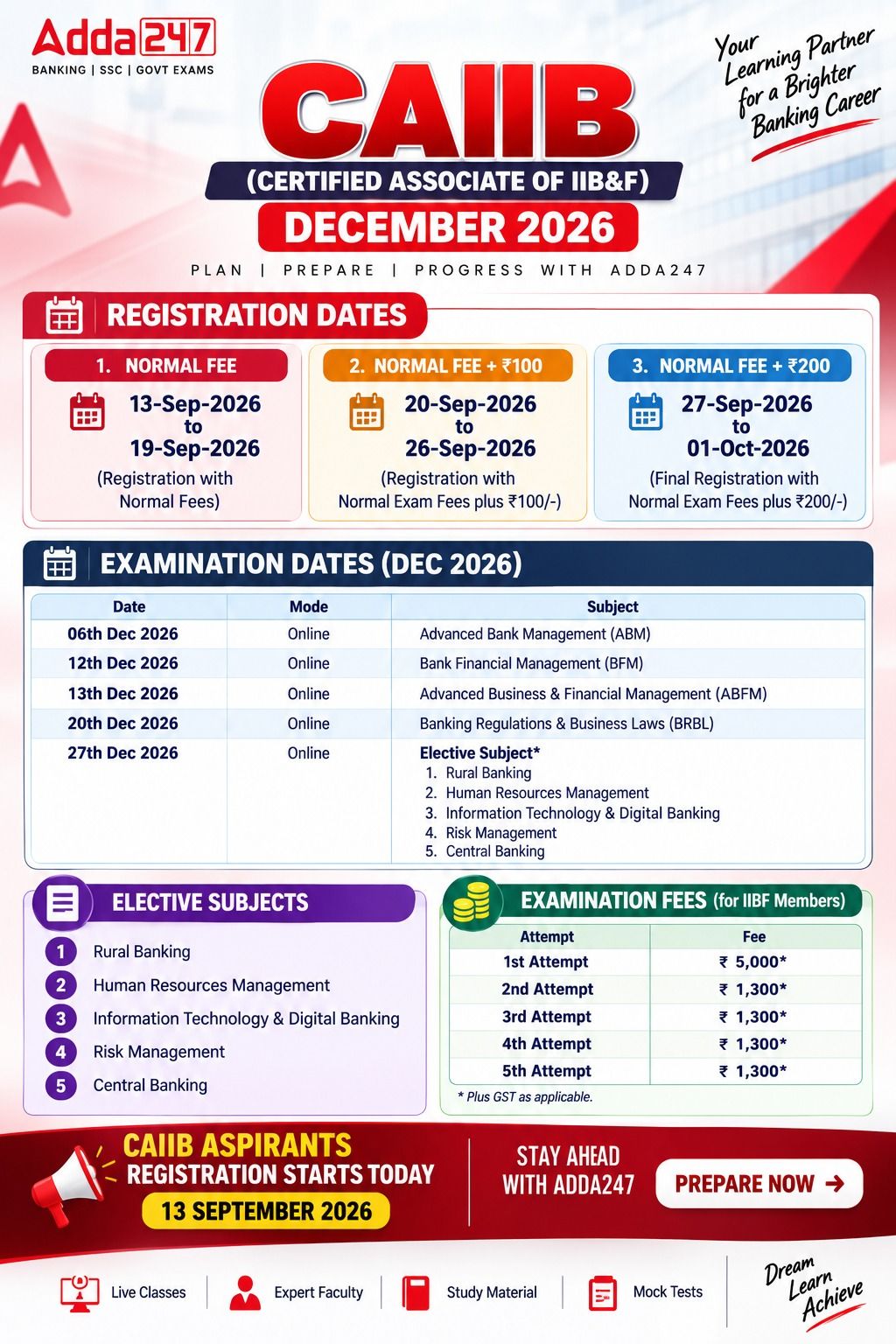
CAIIB Registration 2026 for the December examination cycle is currently available for eligible IIBF members. The registration process for the CAIIB November-December 2026 cycle was scheduled from 13 September to 1 October 2026. Candidates who have not completed their application yet can register through the official IIBF portal within the remaining registration window.

CAIIB Registration 2026 Starts For December Cycle

The December registration process has three fee windows. The normal-fee window ended on 19 September 2026. As of 22 September 2026, candidates are in the second registration window, from 20 September to 26 September 2026, during which an additional ₹100 is applicable. The final window will run from 27 September to 1 October 2026, with an additional ₹200 charge.

The CAIIB December 2026 examination will be conducted from 6 December to 27 December 2026. The examination includes four compulsory papers and one elective paper.

CAIIB Registration 2026: Overview

 
Particulars Details
Exam Name CAIIB December 2026
Conducting Body
Indian Institute of Banking & Finance (IIBF)
Registration Dates 13 September- 01 October 2026
Exam Mode Online
First Exam Date 6 December 2026
Last Exam Date 27 December 2026
Compulsory Papers ABM, BFM, ABFM, BRBL
Elective Papers
Rural Banking, HRM, IT & Digital Banking, Risk Management, Central Banking
Elective Exam Date 27 December 2026
First Attempt Fee ₹5,000*
Second to Fifth Attempt Fee ₹1,300 each*
Late Fee
₹100 / ₹200 depending on registration window
Eligibility
As per IIBF CAIIB examination eligibility rules
Official Site www.iibf.org.in

Need help with CAIIB registration or preparation? Join our CAIIB Helpdesk! 📚

CAIIB Registration 2026: Current Status

As of 22 September 2026, CAIIB December 2026 registration is available. Candidates should note the following registration status:

Registration Window Status as on 22 September 2026 Applicable Fee
13 September to 19 September 2026 Closed Normal Examination Fee
20 September to 26 September 2026 Currently Open Normal Fee + ₹100
27 September to 1 October 2026 Upcoming Normal Fee + ₹200
After 1 October 2026 Registration Window Closed

CAIIB Registration Link

Eligible IIBF members can apply for the CAIIB December 2026 examination through the official online registration portal. Candidates need to log in, enter the required details, choose the examination papers, and complete the fee payment within the prescribed registration period. Before submitting the application, applicants should carefully verify all the information entered to avoid errors.

CAIIB 2026: Click here to Apply Online

Home_11.1

CAIIB Registration 2026 Important Dates

IIBF has provided three registration windows for the December 2026 CAIIB examination. Candidates who register during the first window will pay the applicable normal examination fee, while additional charges will apply during the subsequent windows.

Registration Period Applicable Fee
13 September to 19 September 2026 Normal Examination Fee
20 September to 26 September 2026
Normal Examination Fee + ₹100
27 September to 1 October 2026
Normal Examination Fee + ₹200

CAIIB Eligibility 2026

Candidates must meet the eligibility conditions prescribed by the Indian Institute of Banking & Finance (IIBF) to appear for the CAIIB examination. The key eligibility requirements are:

  • The candidate must be an ordinary member of IIBF.
  • The candidate must have passed the JAIIB examination or the Associate Examination conducted by IIBF.
  • The candidate must have a valid IIBF membership at the time of registration.
  • Candidates must fulfil all other conditions prescribed by IIBF for the CAIIB examination.

CAIIB Exam Fees 2026

The examination fee for IIBF members varies according to the number of attempts. As per the given fee structure, the first attempt carries a fee of ₹5,000, while the second to fifth attempts carry a fee of ₹1,300 each.

Attempt Fee for IIBF Members
First ₹5,000*
Second ₹1,300*
Third ₹1,300*
Fourth ₹1,300*
Fifth ₹1,300*

CAIIB December 2026 Exam Dates

The CAIIB December 2026 examination will be conducted on different dates for the compulsory subjects and elective papers. All the examinations listed in the schedule will be conducted in online mode.

Exam Date Subject
06 December 2026
Advanced Bank Management
12 December 2026
Bank Financial Management
13 December 2026
Advance Business & Financial Management
20 December 2026
Banking Regulations and Business Laws
27 December 2026
Rural Banking / Human Resources Management / Information Technology & Digital Banking / Risk Management / Central Banking

How to Register for CAIIB December 2026?

Candidates can follow the steps below to complete the CAIIB December 2026 registration process:

  • Visit the official IIBF website.
  • Go to the examination or online registration section.
  • Select the CAIIB December 2026 examination.
  • Log in using the required IIBF membership credentials.
  • Enter the required personal and examination details.
  • Select the required elective subject.
  • Check the examination dates and other details carefully.
  • Pay the applicable examination fee.
  • Review the complete application before submitting it.
  • Submit the registration form.
  • Download or save the registration confirmation for future reference.

CAIIB 2026: Documents and Details Required for Registration

Candidates should keep their IIBF membership details and personal information ready before starting the CAIIB December 2026 registration. The registration process mainly requires accurate details related to the candidate’s membership, contact information, examination papers, and payment. Before submitting the form, candidates should check the following:

  • IIBF Membership Number and login credentials.
  • Candidate’s name and personal details as registered with IIBF.
  • Valid mobile number and email ID for communication.
  • Selection of the compulsory and elective papers.
  • Preferred examination centre, wherever applicable.
  • Valid details required for online fee payment.
  • Candidates should also keep the payment receipt and registration confirmation after successful submission for future reference.
Related Posts
CAIIB Salary CAIIB Syllabus
CAIIB Previous Year Question Papers

CAIIB Syllabus and Exam Pattern 2026, Download Syllabus PDF

The CAIIB Syllabus 2026 covers the key banking, financial, and professional concepts that candidates need to study for the examination. The upcoming CAIIB exam will be conducted on 6, 12, 13, 20, and 27 December 2026. Candidates preparing for the examination should understand the subject-wise syllabus and exam pattern in detail to organise their study plan and focus on the topics that carry importance in the exam.

CAIIB Syllabus 2026

The CAIIB exam provides banking and finance professionals with an opportunity to develop deeper knowledge of banking operations, financial management, and other specialised areas. The exam is conducted by the Indian Institute of Banking and Finance (IIBF) and requires candidates to prepare across multiple subjects based on the prescribed syllabus.

CAIIB Syllabus & Exam Pattern 2026

Candidates appearing for the upcoming November/December 2026 examination should prepare according to the latest CAIIB Syllabus 2026 prescribed by IIBF.

CAIIB Syllabus & Exam Pattern 2026
Exam Conducting Body
Indian Institute of Banking and Finance (IIBF)
Exam Name
CAIIB Exam 2026
Category
Syllabus & Exam Pattern
Exam Level National Level
Mode of Exam Online
Type of Questions
Multiple Choice Questions (MCQs)
Number of Papers 5 Papers
Questions per Paper 100 Questions
Maximum Marks per Paper 100 Marks
Time Duration per Paper 2 Hours
Exam Dates (November 2026)
6th, 12th, 13th, 20th & 27th December 2026
Official Website www.iibf.org.in

CAIIB Exam Pattern 2026

The CAIIB Exam Pattern 2026 outlines the structure of the examination, including the number of papers, total questions, marks distribution, and duration for each subject, helping candidates understand how the exam is organized and plan their preparation effectively.

CAIIB Exam Pattern 2026
Papers No. of Qs. Total Marks Duration
Advanced Bank Management 100 100 2 Hours
Bank Financial Management 100 100 2 Hours
Advanced Business and Financial Management 100 100 2 Hours
Banking Regulations and Business Laws 100 100 2 Hours
Elective Paper 100 100 2 Hours

IIBF CAIIB Syllabus 2026

The CAIIB Syllabus 2026 consists of four compulsory papers and one elective paper. Candidates should complete the entire syllabus well before the December examination and dedicate the final weeks to revision and mock tests.

CAIIB Syllabus: CAIIB Compulsory Subjects:

  • Paper 1: Advanced Bank Management(ABM)
  • Paper 2: Bank Financial Management(BFM)
  • Paper 3: Advanced Business and Financial Management (ABFM)
  • Paper 4: Banking Regulations and Business Laws (BRBL)

CAIIB Syllabus: CAIIB Elective Subjects:

  • Rural Banking
  • Human Resources Management
  • Risk Management
  • Central Banking
  • Information Technology and Digital Banking

CAIIB Compulsory Papers Syllabus

The CAIIB Syllabus comprises four mandatory papers:

Paper 1Advanced Bank Management (ABM)

The CAIIB ABM Paper 1 is divided into four modules, covering key areas related to statistics, human resource management, credit management, and banking compliance. Candidates can check the module-wise topics and sub-topics below.

Module A: Statistics

Module A for CAIIB Paper 1, Advanced Bank Management(ABM) is Statistics. The topics and sub-topics for the given module have been discussed in the below table.

Paper 1- Module A: Statistics
Topic Subtopics
Definition of Statistics, Importance & Limitations, Data Collection, Classification & Tabulation Importance of Statistics – Functions of Statistics – Limitations or Demerits of Statistics – Definitions – Collection of Data – Classification & Tabulation – Frequency Distribution
Sampling Techniques Random Sampling – Sampling Distributions – Sampling from Normal Populations – Sampling from Non-Normal Populations – Central Limit Theorem – Finite Population Multiplier
Measures of Central Tendency & Dispersion, Skewness and Kurtosis Arithmetic Mean – Combined Arithmetic Mean – Geometric Mean – Harmonic Mean – Median and Quartiles – Mode – Introduction to Measures of Dispersion – Range and Coefficient of Range – Quartile Deviation and Coefficient of Quartile Deviation – Standard Deviation and Coefficient of Variation – Skewness and Kurtosis
Correlation and Regression Scatter Diagrams – Correlation – Regression – Standard Error of Estimate
Time Series Variations in Time Series – Trend Analysis – Cyclical Variation – Seasonal Variation – Irregular Variation – Forecasting Techniques
Theory of Probability Mathematical Definition of Probability – Conditional Probability – Random Variable – Probability Distribution of Random Variable – Expectation and Standard Deviation – Binomial Distribution – Poisson Distribution – Normal Distribution – Credit Risk – Value at Risk – Option Valuation
Estimation Estimates – Estimator and Estimates – Point Estimates – Interval Estimates – Interval Estimates and Confidence Intervals – Interval Estimates of the Mean from Large Samples – Interval Estimates of the Proportion from Large Samples
Linear Programming Graphic Approach – Simplex Method
Simulation Simulation Exercise – Simulation Methodology

Module B: Human Resource Management

Human Resource Management is the second module of CAIIB Paper 1, Advanced Bank Management(ABM). The below table comprises the topics and sub-topics of Module B.

Paper 1- Module B: Human Resource Management
Topic Subtopics
Fundamentals of Human Resource Management The Perspective – Relationship between HRM & HRD and their Structure and Functions – Role of HR Professionals – Strategic HRM – Development of HR Functions in India
Development of Human Resources HRD and its Subsystems – Learning and Development – Role and Impact of Learning – Attitude Development – Career Path Planning – Self-Development – Talent Management – Succession Planning
Human Implications of Organisations Human Behaviour and Individual Differences – Employees Behaviour at Work – Diversity at Workplace and Gender Issues – Theories of Motivation and their Practical Implications – ‘Role’: Its Concept & Analysis
Employees’ Feedback and Reward System Employees’ Feedback – Reward and Compensation System
Performance Management Appraisal Systems – Performance Review and Feedback – Counselling – Competency Mapping and Assessment of Competencies – Assessment Centres – Behavioural Event Interview (BEI)
Conflict Management and Negotiation Conflict: Concept & Definition – Characteristics of Conflict – Types of Conflicts – Reasons for Conflict – Different Phases of Conflict – Conflict Resolution – Conflict Management – Negotiation Skills for Resolution of Conflicts
HRM and Information Technology Role of Information Technology in HRM – HR Information and Database Management – Human Resource Information System (HRIS) – Human Resource Management System (HRMS) – e–HRM – HR Research – Knowledge Management – Technology in Training – HR Analytics

Module C: Credit Management

The banking and financial sector employees can check the given section for the topics and sub-topics of CAIIB Paper 1(Advanced Bank Management), Module C, Credit Management.

Paper 1- Module C: Credit Management
Topic Subtopics
Overview of Credit Management Importance of Credit – Historical Background of Credit in India – Principles of Credit – Types of Borrowers – Types of Credit – Components of Credit Management – Role of RBI Guidelines in Bank’s Credit Management
Analysis of Financial Statements Which are the Financial Statements – Users of Financial Statements – Basic Concepts Used in Preparation of Financial Statements – Accounting Standards (AS) – Legal Position Regarding Financial Statements – Balance Sheet – Profit and Loss Account – Cash Flow Statement – Funds Flow Statement – Projected Financial Statements – Purpose of Analysis of Financial Statements by Bankers – Rearranging the Financial Statements for Analysis – Techniques used in Analysis of Financial Statements – Creative Accounting – Related Party Transactions
Working Capital Finance Concept of Working Capital – Working Capital Cycle – Importance of Liquidity Ratios – Methods of Assessment of Bank Finance – Working Capital Finance to Information Technology and Software Industry – Bills/Receivables Finance by the Banks – Guidelines of RBI for Discounting/Rediscounting of Bills by Banks – Trade Receivables Discounting System (TReDS) – Non-Fund Based Working Capital Limits – Other Issues Related to Working Capital Finance
Term Loans Important Points about Term Loans – Deferred Payment Guarantees (DPGs) – Difference between Term Loan Appraisal and Project Appraisal – Project Appraisal – Appraisal and Financing of Infrastructure Projects
Credit Delivery and Straight Through Processing Documentation – Third-Party Guarantees – Charge over Securities – Possession of Security – Disbursal of Loans – Lending under Consortium/Multiple Banking Arrangements – Syndication of Loans – Straight-Through Loan Processing or Credit Underwriting Engines
Credit Control and Monitoring Importance and Purpose – Available Tools for Credit Monitoring/Loan Review Mechanism (LRM)
Risk Management and Credit Rating – Meaning of Credit Risk – Factors Affecting Credit Risk – Steps Taken to Mitigate Credit Risks – Credit Ratings – Internal and External Ratings – Methodology of Credit Rating – Use of Credit Derivatives for Risk Management – RBI guidelines on Credit Risk Management – Credit Information System
Restructuring/Rehabilitation and Recovery Credit Default/Stressed Assets/NPAs – Wilful Defaulters – Non-cooperative borrowers – Options Available to Banks for Stressed Assets – RBI Guidelines on Restructuring of Advances by Banks – Available Frameworks for Restructuring of Assets – Sale of Financial Assets
Resolution of Stressed Assets under Insolvency and Bankruptcy Code 2016 Definition of Insolvency and Bankruptcy – To Whom the Code is Applicable – Legal Elements of the Code – Paradigm Shift – Corporate Insolvency Resolution Process – Liquidation process – Pre-packed Insolvency Resolution Process for stressed MSMEs

Module D: Compliance in Banks & Corporate Governance

To know the topic and its sub-topics for CAIIB Paper 1(Advanced Bank Management), Module D, Compliance in Banks and Corporate Governance, candidates can look for the given table.

Paper 1- Module D: Compliance in Banks & Corporate Governance
Topic Subtopics
Compliance Function in Banks Compliance Policy – Compliance Principles, Process and Procedures – Compliance Programme – Scope of Compliance Function – Role & Responsibilities of Chief Compliance Officer (CCO)
Compliance Audit Role of Risk Based Internal Audit and Inspection – Reporting Framework and Monitoring Compliance – Disclosure Requirements – Accounting Standards – Disclosures under Listing Regulations of SEBI
Compliance Governance Structure Organisational Structure – Responsibility of the Board and Senior Management – Compliance Structure at the Corporate Office – Functional Departments – Compliance Structure at Field Levels – Internal Controls and their Importance
Framework for Identification of Compliance Issues and Compliance Risks Compliance Issues – Compliance Risk – Inherent Risk and Control Risk – Independent Testing and Effective Audit Programme – Reporting Framework and Monitoring Compliance – Role of Inspection and Audit – Loan Review Mechanism/Credit Audit – What is Good Compliance
Compliance Culture and GRC Framework How to Create Compliance Culture Across the Organisation – Governance, Risk and Compliance – GRC Framework – Benefits of an Integrated GRC Approach – Whistle-blower Policy – The Components of a Whistle-blower Policy – Reasons for Compliance Failures
Compliance Function and Role of Chief Compliance Officer in NBFCs Framework for Scale-Based Regulation for Non-Banking Financial Companies – Transition Path – Framework for Compliance Function and Role of Chief Compliance Officer in Non-Banking Financial Companies in Upper Layer and Middle Layer (NBFC-UL & NBFC-ML)
Fraud and Vigilance in Banks Definition of Fraud – Definition of Forgery – Areas in which Frauds are committed in Banks – Banking and Cyber Frauds – Fraud Reporting and Monitoring System – Vigilance Function in Banks – RBI Guidelines for Private Sector and Foreign Banks

Paper 2: Bank Financial Management (BFM)

The CAIIB Paper 2: Bank Financial Management (BFM) syllabus is structured into four comprehensive modules: International Banking, Risk Management, Treasury Management, and Balance Sheet Management. Each module covers detailed topics and sub-topics designed to strengthen candidates’ understanding of global banking operations, regulatory frameworks, risk control mechanisms, treasury functions, and balance sheet strategies, ensuring a well-rounded and practical grasp of advanced financial management concepts in banking.

IIBF CAIIB Syllabus Paper 2 Bank Financial Management (BFM) includes the four modules:

Module A: International Banking

Module A for CAIIB Paper 2, Bank Financial Management(BFM) is International Banking. The topics and sub-topics for the given module have been discussed in the below table.

Paper 2- Module A: International Banking
Topic Subtopics
Exchange Rates and Forex Business Foreign Exchange – Definition and Markets – Factors Determining Exchange Rates – Exchange Rate Mechanism – Foreign Exchange Dealing Room Operations – Derivative Products – RBI / FEDAI Guidelines – Foreign Exchange Arithmetic – Concepts and Examples
Liberalised Remittance Scheme (LRS) and other Remittance Facilities for Residents Capital Account Transactions and Current Account Transactions – Key Sections under FEMA vis-à-vis Liberalized Remittance Scheme – Permissible/Non-permissible Remittances under LRS – Operational Guidelines – Remittances under LRS for Current Account Transactions – Tax Collected at Source (TCS) – LRS vis-à-vis Capital Account Transactions – Reporting Requirements under LRS
Correspondent Banking and NRI Accounts Correspondent Banking – Accounts and other Services – Nostro, Vostro and Loro Accounts – Electronic Modes of Transmission/Payment Gateways – SWIFT, CHIPS, CHAPS, RTGS, etc. – NRI Banking – NRI accounts – Rupee and Foreign Currency Accounts – Facilities to NRIs – Advances to Non-Residents against Non-Resident Deposits – Housing Loans to Non-Resident Indians
Documentary Letters of Credit Definition of Letter of Credit – Types of Letters of Credit – Operations of Letter of Credit – UCP 600 and Important Articles – Liabilities, Responsibilities and Rights of the Parties – Documents under LC – Scrutiny, Crystallization, Follow-up for Bills under LC and Safeguards for Banks – Risks Relating to LC Transactions – Standby Letter of Credit (Similar to Guarantees) – Uniform Rules for Bank-to-Bank Reimbursements (URR–725) – International Standard Banking Practice – 745 (ISBP 745) – Incoterms – Case Studies
Facilities for Exporters and Importers Exchange and Trade Control Guidelines for Exporters – Facilities for Exporters – Export Finance – Gold Card Scheme for Exporters – Export Data Processing and Monitoring System (EDPMS) – Factoring and Forfaiting – Exchange and Trade Control Guidelines for Importers – Import Finance – Import Data Processing and Monitoring System (IDPMS) – Trade Credit – Supplier’s Credit and Buyer’s Credit – Case Study on Export Finance
External Commercial Borrowings and Foreign Investments in India External Commercial Borrowings – Concepts – ECBs – Other Operational Concepts – Reporting Requirements – Conversion of ECB into Equity – Foreign Investments – Key Concepts – Eligible Foreign Investors – Eligible Investee Entities – Eligible Investment Instruments – Prohibited Sectors – Rules Governing Pledge of Shares – Operational Guidelines – Snap Shot of Non-Debt Instruments (NDI) Rules – List of Documents for Obtention of Foreign Investments – List of Documents for Refund of Foreign Investments
Risks in Foreign Trade – Role of ECGC Definition of Risk and Risks in International Trade – Country Risk – Export Credit Insurance in International Trade – ECGC Role and Products – ECGC Policies – ECGC’s Products for Banks – Other Aspects Relating to ECGC Policies and Guarantees – Some of the Common “To Do Points” under ECGC Policies – Claims
Role of EXIM Bank, Reserve Bank of India, Exchange Control in India – FEMA, FEDAI and Others EXIM Bank – Role, Functions and Facilities – Reserve Bank of India – Role and Exchange Control Regulations in India – Foreign Exchange Management Act (FEMA) 1999 – Role of FEDAI and FEDAI Rules – Short Notes on Other Topics: ECB and ADR/GDRs and FCCB;
International Financial Service Centres (IFSC), GIFTCity Scope of IFSC in India – Opportunities at Gift City – Guidelines relating to setting up of IFSC Banking Units (IBUs) – Role of IFSCA – Regulatory Framework – Permissible Activities at IBUs – Relaxations for the FPI (Foreign Portfolio Investors) Entities at GIFT City
Technology in International Banking Introduction to Digitization in International Banking – An Overview – Evolution of Technology in International Banking – Benefits and Limitations of Technology in International Banking – Digital Platforms in International Banking – FINTECH and Evolution of FINTECH in International Banking – Delivery channels under FINTECH in International Banking – Sample process of International Trade Using Blockchain Technology – Challenges in FINTECH

Module B: Risk Management

Risk Management is the second module of CAIIB Paper 2, Bank Financial Management(BFM). The table below comprises the topics and sub-topics of Module B.

Paper 2- Module B: Risk Management
Topic Subtopics
Risk and Basic Risk Management Framework What is Risk? – Linkages among Risk, Capital and Return – Why Risk Management? – Basic Risk Management Framework
Risks in Banking Business Risk Identification in Banking Business – The Banking Book – The Trading Book – Off-Balance Sheet Exposures – Banking Risks – Definitions
Risk Regulations in the Banking Industry Regulation of Banking Industries – Necessities and Goals – The Need for Risk-based Regulation in a Changed World Environment – Basel I: The Basel Capital Accord – 1996 Amendment to Include Market Risk – Basel II Accord – Need and Goals – Basel II Accord – Towards Basel III – Capital Charge for Credit Risk – Credit Risk Mitigation – Capital Charge for Market Risk – Capital Charge for Operational Risk – Pillar 2 – Supervisory Review Process – Pillar 3 – Market Discipline – Capital Conservation Buffer – Leverage Ratio – Countercyclical Capital Buffer – Systemically Important Financial Institutions (SIFIs) – Risk Based Supervision (RBS)
Market Risk Market Risk – Concept – Market Risk in Banks – Market Risk Management Framework – Organisation Structure – Risk Identification – Risk Measurement – Risk Monitoring and Control – Risk Reporting – Managing Trading Liquidity – Risk Mitigation
Credit Risk General – Credit Risk Management Framework – Organisation Structure – Risk Identification – Risk Measurement – Credit Risk Control and Monitoring – Credit Risk Policies and Guidelines at Transaction Level – Credit Control and Monitoring at Portfolio Level – Active Credit Portfolio Management – Controlling Credit Risk through Loan Review Mechanism (LRM) – Credit Risk Mitigation – Securitisation – Credit Derivatives (CDs)
Operational Risk and Integrated Risk Management Operational Risk – General – Operational Risk – Classification – Operational Risk Classification by Event Type – Definitions – Operational Risk Management Practices – Management Overview and Organisational Structure – Processes and Framework – Risk Monitoring and Control Practices – Operational Risk Qualification – Operational Risk Mitigation – Scenario Analysis – Integrated Risk Management – The Necessity of Integrated Risk Management – Integrated Risk Management – Challenges – Integrated Risk Management – Approach
Liquidity Risk Management Liquidity Risk Management – Need & Importance – Potential Liquidity Risk Drivers – Types of Liquidity Risk – Principles for Sound Liquidity Risk Management – Governance of Liquidity Risk Management – Liquidity Risk Management Policy, Strategies and Practices – Management of Liquidity Risk – Ratios in respect of Liquidity Risk Management – Stress Testing – Contingency Funding Plan – Overseas Operations of the Indian Banks’ Branches and Subsidiaries and Branches of Foreign Banks in India – Broad Norms in Respect Of Liquidity Management – Liquidity Across Currencies – Management Information System – Reporting to the Reserve Bank of India – Internal Controls
Basel III Framework on Liquidity Standards Liquidity Coverage Ratio – Liquidity Risk Monitoring Tools – Net Stable Funding Ratio

Module C: Treasury Management

The banking and financial sector employees can check the given section for the topics and sub-topics of CAIIB Paper 2(Bank Financial Management), Module C, Treasury Management.

Paper 2- Module C: Treasury Management
Topic Subtopics
Introduction to Treasury Management The Concept – Functions of Integrated Treasury – The Process of Globalisation – Evolving Role of Treasury as Profit Centre – Organisation of Treasury
Treasury Products Products of Foreign Exchange Markets – Money Market Products – Securities Market Products – Domestic and Global Markets
International Equity and Debt Products Regulatory Environment – Global Depository Receipts – Indian Depository Receipts – External Commercial Borrowings – Trade Credits – Rupee Denominated Bonds
Funding and Regulatory Aspects Reserve Assets: CRR and SLR – The Liquidity Adjustment Facility (LAF) – Payment and Settlement Systems
Treasury Risk Management Supervision and Control of Treasury – Market Risk and Credit Risk – Risk Measures: VaR and Duration – Use of Derivatives in Risk Management
Derivative Products Derivatives and the Treasury – OTC and Exchange Traded Products – Forwards, Options, Futures and Swaps – Interest Rate and Currency Swaps
Treasury and Asset-Liability Management Meaning of Asset-Liability Management (ALM), Liquidity Risk and Interest Rate Risk, Role of treasury in ALM, Use of derivatives in ALM, Credit risks and Credit Derivatives, Transfer pricing, Policy Environment

Module D: Balance Sheet Management

To know the topic and its sub-topics for CAIIB Paper 2(Bank Financial Management), Module D, Balance Sheet Management, candidates can look for the given table.

Paper 2- Module D: Balance Sheet Management
Topic Subtopics
Components of Assets and Liabilities Components of a Bank’s Balance Sheet – What is Asset Liability Management? – Significance of Asset Liability Management – Purpose and Objectives of Asset Liability Management – ALM as Co-ordinated Balance Sheet Management
Capital Adequacy – Basel Norms Scope of Application – Pillar-1 – Minimum Capital Requirements – Pillar 2- Supervisory Review Process – Pillar 3 – Market Discipline
Asset Classification and Provisioning Norms Asset Classification – Provisioning Norms
Liquidity Management Definition – Dimensions and Role of Liquidity Risk Management – Measuring and Managing Liquidity Risk
Interest Rate Risk Management Essentials of Interest Rate Risk – Sources of Interest Rate Risk – Effects of Interest Rate Risk – Measurement of Interest Rate Risk – Interest Rate Risk Measurement Techniques – Strategies for Controlling Interest Rate Risk – Controls and Supervision of Interest Rate Risk Management – Sound Interest Rate Risk Management Practices – RBI’s Draft Guidelines on Interest Rate Risk in Banking Book
RAROC and Profit Planning Profit Planning – Risk Aggregation and Capital Allocation – Economic Capital and RAROC

pdpCourseImg

Paper 3: Advanced Business and Financial Management (ABFM)

CAIIB Paper 3 Advanced Business and Financial Management also contains four vast modules, the topics and sub-topics of which have been discussed below.

Module A: The Management Process

Module A for CAIIB Paper 3, Advanced Business and Financial Management(ABFM) is The Management Process. The topics and sub-topics for the given module have been discussed in the below table.

Paper 3- Module A: The Management Process
Topic Subtopics
Basics of Management Definition of Management – The Management Process – Functions of Management – Importance of Management – Management Thoughts & Approaches – Management Challenges & Opportunities – Introduction to Strategic Management – Business Environment Analysis
Planning Fundamentals of Planning – Steps in Planning – Importance of Planning – Advantages and disadvantages of planning – Management by Objectives – Plan Components – Contingency planning – Forecasting & Decision Making
Organizing Introduction and Fundamentals of Organizing – Importance of Organisation – Stages in Organising Process – The Organising Process – Principles of organizing – Types of Organisations – Organisation structure – Organisation charts and manuals – The Organisation culture – Authority & Responsibility – Key Issues in Organisation Structure – Organisational Change – Conflict Dynamics
Staffing Functions of Staffing – Objectives of staffing – Nature of staffing – Facets of staffing – Significance of staffing – System approach to staffing – Recruitment – Selection – Training – Retention and development – Knowledge and learning management – Performance Appraisal – Human Resource Development
Directing Characteristics of directing – Importance of directing – Elements of directing – Leadership – Motivation – Communication – Supervision
Controlling Basics of Controlling – Characteristics of controlling – Advantages of controlling – Limitations of controlling – Types of control management – Control process – Relation between planning and control – Control Techniques – Control technique and Information Technology

Module B: Advanced Concepts of Financial Management

Advanced Concepts of Financial Management is the second module of CAIIB Paper 3, Advanced Business and Financial Management(ABFM). The below table comprises the topics and sub-topics of Module B.

Paper 3- Module B: Advanced Concepts Of Financial Management
Topic Subtopics
Sources of Finance and Financial Strategies Equity Capital – Internal Accruals – Preference Capital – Term Loans – Debentures – Alternative Financing Strategies in the Context of Regulatory Requirements
Financial and Operating Leverages Financial Leverage – Degree of Financial Leverage and its Behaviour – Operating Leverage – Degree of Operating Leverage and its Behaviour – Combined or Total Leverage
Capital Investment Decisions Objective of capital investment decisions – Estimation of project cash flows – Forecasting and its relation to regulation of capital for short, medium and long-term periods – Relationship between sales, production and other functional budgets – Cash Forecasts – Cost analysis for projects – Methods of Investment appraisal – Social Cost Benefit Analysis
Capital Budgeting for International Project Investment Decisions Foreign Investment Analysis – Special Considerations-Foreign & Home Currency Cash Flows – Foreign Currency Discount Rates Computation – International Portfolio Investment – Institutional Constraints – Direct and Indirect Channels for International Portfolio Investment – Exchange and Country Risk – Return and Risk of Foreign Investment – Capital Asset Pricing model – Arbitrage pricing theory – International Capital Budgeting Issues involved in overseas projects – Approaches for evaluation of overseas projects – Evaluation methods – Impact of transfer pricing
Adjustment of Risk and Uncertainty in Capital Budgeting Decision – Sources & Perspectives on Risk – Sensitivity Analysis – Scenario Analysis – Hillier Model – Simulation Analysis – Decision Tree Analysis – Corporate Risk Analysis – Managing Risk – Project Selection Under Risk – Risk Analysis in Practice
Decision Making Decision Making using Cost-Volume-Profit (CVP) Analysis – Decision Making using Relevant Cost Concepts – Decision Making using Activity Based Costing – Ethical and Non-Financial Considerations Relevant to Decision Making

Module C: Valuation, Mergers & Acquisitions

The banking and financial sector employees can check the given section for the topics and sub-topics of CAIIB Paper 3(Advanced Business and Financial Management), Module C, Valuation, Mergers, and Acquisitions.

Paper 3- Module C: Valuation, Mergers & Acquisitions
Topic Subtopics
Corporate Valuations Approaches to Corporate Valuation – Adjusted Book Value Approach – Stock and Debt Approach – Direct Comparison Approach – Discounted Cash Flow Approach – Steps involved in valuation using DCF Approach
Discounted Cash Flow Valuation Estimating Inputs – Approaches to Discounted Cash Flow Models – Various Discounted Cash Flow Models – Dividend Discount Model – Applicability of the Dividend Discount Model
Other Non-DCF valuation models Relative valuation model – Equity Valuation Multiples Model – Enterprise value multiples Model – Choosing the right multiples – Book value approach Model – Stock and debt approach
Special cases of valuation Intangibles –Brand, Human valuation etc. – Real estate Firms – Start-up firms – Firms with negative or low earnings – Financial Service companies – Distressed firms – Valuation of cash and cross holdings – Warrants and convertibles – Cyclical & non-cyclical companies – Holding companies – E-commerce firms
Mergers, Acquisitions and Restructuring Types of Transactions – Reasons for Merger – Mechanics of a Merger – Costs and Benefits of a Merger – Exchange Ratio in a Merger – Purchase of a Division / Plant – Takeovers – Leveraged Buyouts – Acquisition Financing – Business Alliances – Managing Acquisitions – Divestitures – Holding Company – Demergers
Deal structuring and financial strategies – Negotiations – Payment and legal considerations – Tax and accounting considerations – Tax reliefs and benefits in case of Amalgamation in India – Financial reporting of business combinations – Deal Financing – Financing of cross-border acquisitions in India

Module D: Emerging Business Solutions

To know the topic and its sub-topics for CAIIB Paper 3(Advanced Business and Financial Management), Module D, Emerging Business Solutions candidates can look for the given table.

Paper 3- Module D: Emerging Business Solutions 
Topic Subtopics
Hybrid Finance Advantages and disadvantages of Hybrid securities – Types of hybrid securities – Preference Share Capital – Features of Warrants – Features of Convertible Debentures – Differences between Warrants and Convertible debentures – Valuation of Warrants – Valuation of Compulsorily Convertible (Partly or fully) Debentures – Objective of issuing Warrants and Convertible debentures – Features of Foreign Currency Convertible Bond (FCCB) – Mezzanine Financing – Innovative Hybrids
Start-up Finance – Benefits to startups under the Startup Plan – Startup definition in India – Challenges faced by Startups – State Startup Policy – Pitch Presentation – Programmes and competitions for startups – Tax exemptions – Funding – Investor’s outlook in Startups – Funding schemes and programmes – International challenges and bridges
Private Equity and Venture Capital – Characteristics of Venture Capital Investments – Characteristics shared by Private Equity and Venture Capital as well as their key distinctions – Financing options available through Venture Capital – Investment in Private Equity – Benefits obtained through private equity – Drawbacks to the practice of private equity – Due diligence – Exit Strategies
Artificial Intelligence – History of Artificial Intelligence – Applicability of Artificial Intelligence – Artificial Intelligence in Banking and Finance – The future scope of Artificial Intelligence – Neural Networks – Control Theory and Cybernetics – Rational Agents – Motion and Manipulation – Tools and Techniques of Artificial Intelligence – Artificial Intelligence and Morality
Business Analytics as a Management Tool – Essentials of Business Analytics – Types of Analytics – Elements of Business Analytics – Big Data Analytics – Web and Mobile Analytics – Comparing web vs. mobile Analytics – Importance of Business Analytics
Green and Sustainable Financing – ISO Standards for Green Finance – Building Green Finance – International Best Practices towards Green Finance – Public Policy in India – Progress of Green Finance in India – Challenges and way forward – Growth of Regulatory Framework – National Efforts towards Green and Sustainable Financing – RBI Views on Climate Risk and Sustainable Finance
Special Purpose Acquisition Company – Advantages of SPAC – Disadvantages of SPAC – SPAC Formation and Timelines – The SPAC Merger – Stakeholders – Characteristics of SPACs – Process – SPAC Capital Structure – Trust Account – Warrants – Forward Purchase – IPO Agreements – De-SPAC Process

CAIIB  Syllabus-Click Here To Download PDF

Paper 4: Banking Regulation and Business Laws(BRBL)

CAIIB Syllabus Paper 4 of Banking Regulations & Business Laws (BRBL) has four modules, which have been explained in detail below.

Module A: Regulations & Compliance

Module A for CAIIB Paper 4, Banking Regulations & Business Laws, is Regulations and Compliance. The topics and sub-topics for the given module have been discussed in the table below.

Paper 4- Module A: Regulations & Compliance
Topic Subtopics
Legal Framework of Regulation of Banks Business of Banking – Constitution of Banks – Reserve Bank of India Act, 1934 – Banking Regulation Act, 1949 – Reserve Bank as a Central Bank and Regulator of Non-Banking Financial Institutions/Banks – Government as a Regulator of Banks – Control over Co-operative Banks – Regulation by Other Authorities
Control over Organisation of Banks Licensing of Banking Companies including RBI Licensing Policy for Universal Banks and Small Finance Banks/Branch Licensing – Paid-up Capital and Reserves – Shareholding in Banking Companies – Subsidiaries of Banking Companies – Board of Directors – Chairman of Banking Company – Appointment of Additional Directors – Restrictions on Employment – Controls over Management – Corporate Governance – Directors and Corporate Governance
Regulation of Banking Business Power to Issue Directions – Acceptance of Deposits – Nomination – Loans and Advances – Regulation of Interest Rates – Regulation of Payment Systems – Internet Banking Guidelines – Regulation of Money Market Instruments – Banking Ombudsman – Regulation to Strengthen Financial Stability
Returns, Inspection, Winding Up, Mergers & Acquisitions Annual Accounts and Balance Sheet – Audit and Auditors – Submission of Returns – Preservation of Records and Return of Paid Instruments – Special Audit – Inspection and Scrutiny – Board for Financial Supervision – Acquisition of Undertakings – Amalgamation of Banks – Winding up of Banks – Penalties for Offences
Non-Banking Financial Companies (NBFCs) Regulators of NBFCs – Role of NBFC in promoting Inclusive Growth – Registration – Revised Scale Based Regulatory Structure – Nomenclature and Regulatory Norms – Capital Guidelines – Prudential Guidelines – Corporate Governance – Fair Practices Code for applicable NBFC – Bank Finance to NBFCs registered/not requiring registration with RBI – Co-Lending by banks and NBFCs to PSA

Module B: Important Laws/Acts & Legal Aspects of Banking Operations- Part A

Important Laws/Acts and Legal Aspects of Banking Operations- Part A is the second module of CAIIB Paper 4, Banking Regulations and Business Laws(BRBL). The below table comprises the topics and sub-topics of Module B.

Paper 4- Module B: Important Laws/Acts & Legal Aspects of Banking Operations- Part A
Topic Subtopics
The Prevention of Money Laundering Act, 2002 Offence of Money Laundering – Punishment for Money Laundering – Obligations of Banking Companies, Financial Institutions and Intermediaries – Enhanced Due Diligence – Rules Framed – Records to be Maintained – Information Contained in the Records – Procedure for Maintaining Information – Procedure for Furnishing Information to the Director – Verification of Records of the Identity of Clients – Maintenance of Records of Identity of Clients – Some Cases pertaining to the Act
Negotiable Instruments Act, 1881 Negotiable Instruments, Types and Characteristics – Drawer/Acceptor – Payment of Cheques – Protection to Bankers’ /Customers’ – Material Alteration – Where Alteration is not apparent – Protection to the Collecting Banker
Foreign Exchange Management Act, 1999 Meaning of Certain Important Terms Used in FEMA – Regulation and Management of Foreign Exchange – Powers of RBI with Respect to Authorized Persons – Contravention, Penalties, Adjudication and Appeals – Directorate of Enforcement – Special Provisions relating to Assets held outside India
Payment & Settlement Systems Act, 2007 Definitions – Designated Authority/Authorization – Regulation and Supervision by the RBI – Settlement and Netting – Power of RBI to make regulations
Law Relating to Securities and Modes of Charge – I Mortgage – Document of Title to Immoveable Property – Meaning – Copy of Document of Title to Immoveable Property Where Acceptable
Law Relating to Securities and Modes of Charge – II Appropriation – Assignment – Pledge – Hypothecation – Bankers lien – Set-off
Creation/Registration and Satisfaction of Charges What is a Charge? – Procedure for Registration of Charge – Effect of Registration of Charges – Effect of Non-registration of Charges – Provisions of Companies Act 2013 Relating to Registration of Charges

Module C: Important Laws/Acts & Legal Aspects of Banking Operations- Part B

The banking and financial sector employees can check the given section for the topics and sub-topics of CAIIB Paper 4(Banking Regulations and Business Laws), Module C, Important Laws/Acts and Legal Aspects of Banking Operations-Part B.

Paper 4- Module C: Important Laws/Acts & Legal Aspects of Banking Operations- Part B
Topic Subtopics
Reserve Bank – Integrated Ombudsman Scheme, 2021 Coverage and Definitions – Ombudsman–Appointment/Location of Offices/Establishment of a Centralized Receipt and Processing Centre – Procedure for Redressal of Grievance – Procedure for Filing a Complaint / its Initial Scrutiny and Resolution – Passing of an Award and Right to Prefer to Appeal – Suspension of the Scheme
The Micro, Small and Medium Enterprises Development Act, 2006 Coverage and Definitions – Summary of Regulation – National Board for Micro, Small and Medium Enterprises (NBMSME)/Advisory Committee – Memorandum of Micro, Small and Medium Enterprises – Delayed Payments to Micro and Small Enterprises – Micro and Small Enterprises Facilitation Council and Reference to the Council in case of Disputes – Disclosures and Penalty for Contravention of the Provisions of the Statute
Introduction to Securitisation and Reconstruction of Financial Assets and Enforcement of Security Interest Act, 2002 (SARFAESI Act, 2002) Constitutional Validity of the Act – Definitions Under SARFAESI Act, 2002 – Preamble, Appellate Tribunal, Asset Reconstruction, Bank, Board, Borrower, Central Registry, Debt Recovery Tribunal, Default, Financial Assistance, Financial Asset, Financial Institution, Hypothecation, Non-performing Asset, Originator, Obligor, Property, Qualified Institutional Buyer, Scheme, Securitization, Security Agreement, Secured Asset, Secured Creditor, Secured Debt, Security Interest, Security Receipt, Sponsor
Regulation of Securitisation and Reconstruction of Financial Assets of Banks and Financial Institutions Registration of Asset Reconstruction Company, Cancellation of Certificate of Registration, Acquisition of Rights of Interest in Financial Assets, Notices to Obligor and Discharge of Obligation of Such Obligor, Issue of Security Receipts and Raising of Funds by Securitization or Reconstruction Company, Exemption from Registration of Security Receipt, Measures of Assets Reconstruction, Other Functions of the Securitization Company or Reconstruction Company, Resolution of Dispute, Powers Available with RBI
Enforcement of Security Interest Enforcement of Security Interest, Chief Metropolitan Magistrate or District Magistrate’s Assistance for Taking Possession of Secured Asset, Manner and Effect of Takeover of Management, No Compensation to Directors for Loss of Office, Application against Measures to Recover Secured Debt, Appeal to Appellate Authority, Right of the Borrower for Compensation and Costs
Central Registry Central Registry, Central Registrar, Register of Securitization, Reconstruction and Security Interest Transactions, Filing of Transactions of Securitization, Reconstruction and Creation of Security Interest, Modification of Security Interest Registered, Satisfaction of Security Interest, Right to Inspect Particulars of Securitization, Reconstruction of Security Interest Transactions
Offences and Penalties Penalties, Penalties for Non-compliance of Directions of Reserve Bank of India, Offences, Cognizance of Offences, Power of Adjudicating Authority to Impose Penalty/Appeals against Penalty and Adjudicating Appellate Authority
Miscellaneous Provisions Non-Applicability of the Provisions of the SARFAESI Act in Certain Cases, Exemption of Certain Classes of Banks /Financial Institutions, Protection of Action Taken in Good Faith, Offences by Companies, Civil Court not to have Jurisdiction, Overriding Effect on Other Laws, Limitation, Power of the Central Government to Make Rules, Amendments to Certain Other Enactments
Registration of Security Interest by Secured Creditors and Other Creditors/ Rectification by the Central Government in Some Cases Registration by Secured Creditors and Other Creditors, Rectification by Central Government in Matters of Registration, Effect of the Registration of Transactions, Right of Enforcement of Securities and Priority Allowed to Secured Creditors
The Recovery of Debts and Bankruptcy Act, 1993 Constitutional Validity of the Act, Extent, Commencement, Application and Definitions – Establishment of Tribunal and Appellate Tribunal – Jurisdiction, Powers & Authority of Tribunals – Procedure of Tribunals – Recovery of Debts Determined by Tribunal and Miscellaneous Provisions
Introduction to the Insolvency and Bankruptcy Code, 2016 Definitions, Coverage, Pillars of IBC, 2016, The Insolvency Resolution Process for Companies and Limited Liability Entities, Corporate Insolvency Resolution Process (CIRP), Initiation of Corporate Insolvency Resolution Process by a Financial Creditor, Suspension of Initiation of CIRP, Persons not Entitled to Make Application, Time – Limit for completion of Insolvency Resolution Process and withdrawal of application admitted under the Code, Declaration of Moratorium and Public Announcement by the Adjudicating Authority, Appointment/Tenure of the Interim Resolution Professional, Committee of Creditors, Appointment of Resolution Professional, Liquidation, Order of Priority of Payment of Debts, Fast Track Insolvency Resolution Process, Voluntary Liquidation of Corporate Person
The Bankers’ Books Evidence Act, 1891 Applicability and Definitions, Conditions in the Printout, Mode of Proof of Certain Entries in Bankers’ Books, Case in which Officer of Bank not Compellable to Produce Books, Inspection of Books by Order of Court or Judge, Costs of Application
The Legal Services Authorities Act, 1987: Lok Adalats Organization of Lok Adalats, Jurisdiction of Lok Adalats, Cognizance of Cases by Lok Adalats, Disposal of Cases by Lok Adalats, Nature of Award of the Lok Adalats and Powers
The Consumer Protection Act, 2019 Definitions, Unfair Contract and Unfair Trade Practice, Central, State and District Consumer Protection Councils, Central Consumer Protection Authority, District, State and National Consumer Disputes Redressal Commission, Ministry of Consumer Affairs, Food and Public Distribution (Department of Consumer Affairs) Notification dated 30th December, 2021, Finality of Orders and Limitation Period, Consumer Mediation Cell
The Law of Limitation Definitions, Limitations and Their Computation, Computation of the Period of Limitation, Acts Giving Rise to a Fresh Period of Limitation, Certain Important Provisions in the Schedule to the Limitation Act
Tax Laws Income Tax, Commodity Transaction Tax, Goods and Services Tax

Module D: Commercial & Other Laws with Reference to Banking Operations

To know the topic and its sub-topics for CAIIB Paper 4(Banking Regulations and Business Laws), Module D, Commercial and Other Laws, with reference to banking operations, candidates can look for the given table.

Paper 4- Module D: Commercial & Other Laws with Reference to Banking Operations
Topic Subtopics
Meaning and Essentials of a Contract Meaning of Contract, Key Components to Form a Contract, Essentials of a Valid Contract, Contract Act and Banking
Contracts of Indemnity Rights of Indemnity Holder, Implied Indemnity, Enforceability of Contract of Indemnity
Contracts of Guarantee Parties to the Contract, Basic Principles of Contract, Consideration, The Liability of the Surety, Continuing Guarantee, Death of Surety, Variance in Terms, Discharge of Principal Debtor, Forbearance to Sue, Release of Co-surety, Surety’s Dues, Security, Misrepresentation, Implied Promise, Co-sureties, Revocation
Contract of Bailment Meaning, Essential Features, Bailor’s Disclosure, Bailee’s Care of Goods, Mixing of Goods, Duties of Bailee, Bailee’s Lien
Contract of Pledge Ingredients, Nature, Pledge by Way of Hypothecation, Pledge by Pledgee
Contract of Agency Definition, Essential Characteristics, Rules, Types of Agents, Rights and Duties of the Agent and Principal
Meaning & Essentials of a Contract of Sale Important Terms Defined, Features, Sale vs Agreement to Sell, Distinction
Conditions and Warranties Meaning, Implied Conditions and Warranties
Unpaid Seller Rights of an Unpaid Seller
Definition, Meaning and Nature of a Partnership Meaning, Essential Characteristics, Types, Limited Liability Partnership (LLP)
Relations of Partners General Duties, Duty to Indemnify, Rights and Duties by Contract, Conduct of Business, Mutual Rights and Liabilities, Property of the Firm, Profits, Rights and Duties
Relations of Partners to Third Parties Partner as Agent, Implied Authority, Extension and Restriction of Authority, Partner’s Liability, Firm’s Liability, Firm’s Misapplication, Holding Out, Rights of Transferee
Minor Admitted to the Benefit of a Partnership Legal Position, Retirement, Insolvency
Dissolution of a Firm Causes, Modes, Liabilities
Effect of Non-Registration Registration
Definition and Features of a Company Features, Distinction from Partnership
Types of Companies Mode of Incorporation, Liability, Public Interest, Holding and Subsidiary
Memorandum of Association and Articles of Association Definitions, Effect, Distinction
Doctrines of Ultra Vires/Constructive Notice/Indoor Management Definitions, Effects, Constructive Notice, Indoor Management
Membership of the Company Who is a Member, Modes of Becoming a Member, Cessation, Register, Rights and Duties
Prospectus Definition, Compliance, Mis-statements, Remedies
Directors Minimum Number, Appointment, Retirement, Rights, Duties, Powers, Compensation
Limited Liability Partnership Act, 2008 Definitions, Incorporation, Partners and Relations, Conversion
Transfer of Property Act, 1882 Sale of Immovable Property, Mortgage, Leases, Actionable Claims
The Right to Information Act, 2005 Applicability, Definitions
Right to Information & Obligations of Public Authorities Obligations of Public Authorities, Procedure, Disposal of Request, Appeal, Penalties
Information Technology Act, 2000 Definitions, Electronic Governance, Certifying Authorities, Digital Signature, Certificates, Penalties, Appeal, Investigation, Critical Information Infrastructure –Protected System, Application to Electronic Cheque and Truncated Cheque
Prevention of Corruption Act, 1988 Definitions, Special Judges, Offences, Penalties, Fixing of Fines, Persons authorized to investigate,
Powers to inspect ‘Bankers Books’, Appeal and Revision Investigation, Powers, Appeal

CAIIB 2026 Exam Marking Scheme

The CAIIB 2026 marking scheme is straightforward, with no penalty for incorrect answers. Candidates should know the key details before planning their exam attempts.

  • Total Papers: 5 (4 compulsory + 1 elective)
  • Questions: 100 objective-type questions per paper
  • Marks: 1 mark for each correct answer
  • Negative Marking: No negative marking
  • Exam Duration: 2 hours (120 minutes) per paper

Passing Criteria & Attempts for CAIIB 2026 Exam

To successfully clear the CAIIB 2026 Exam, candidates must meet certain passing criteria and follow the attempt rules set by IIBF. Below are the important details regarding marks, number of attempts, and validity:

Passing Criteria:

  • To pass the exam, candidates must score 50 marks out of 100 in each paper to pass.
  • Alternatively, candidates can pass if their score at least 45 marks in each paper and have an overall average of 50% or more in one single attempt.

Attempts & Validity:

  • Candidates will get 5 attempts to pass all the papers.
  • These 5 attempts must be used within 3 years from the date of your first registration.
  • The attempts do not have to be consecutive.
  • If candidates pass a paper, the result will remain valid only during the 3-year period.
  • If candidates exceed 5 attempts or the 3-year time limit, then they must register again, and previous results will be invalid.

consistent evaluation standard and maintain the quality and credibility of the CAIIB certification, which is widely recognized in the banking and finance industry.

What is the Rule of Marks in the CAIIB Exam?

The CAIIB Syllabus 2026 follows the passing criteria prescribed by the Indian Institute of Banking and Finance (IIBF). Candidates must satisfy the minimum qualifying requirements in each paper to successfully complete the CAIIB examination. The rules of marks are as follows:

  • Candidates must secure at least 50 marks out of 100 in each paper to qualify.
  • Alternatively, candidates scoring 45 or more marks in every paper with an overall aggregate of 50% or above in a single attempt will also be declared as having passed the examination.
  • The credits earned for papers successfully cleared will remain valid until the expiry of the prescribed time limit for completing the CAIIB examination, as per the IIBF guidelines.

These well-defined rules ensure a fair and transparent evaluation process while maintaining the high standards and credibility of the CAIIB certification. Candidates preparing according to the CAIIB Syllabus 2026 should familiarize themselves with the passing criteria to set realistic score targets and plan their preparation effectively for the upcoming November/December 2026 CAIIB examination.

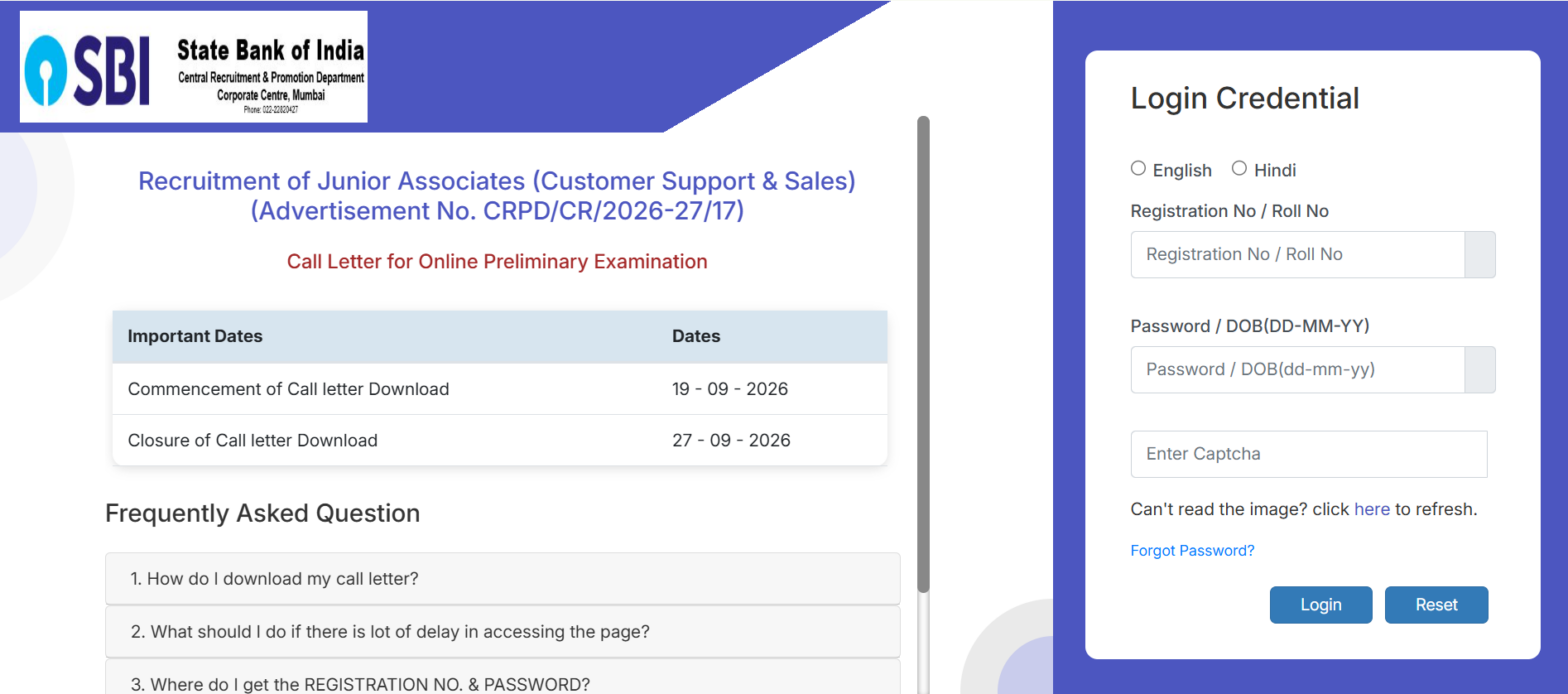
Related Posts:
CAIIB Salary
CAIIB Eligibility Criteria
CAIIB Previous Year Papers
CAIIB Exam Date 2026
CAIIB Online Coaching


IBPS RRB Apply Online Last Date Extended till 27 September 2026, Check Official Notice

The Institute of Banking Personnel Selection has revised the application schedule for IBPS RRB CRP-RRBs-XV 2026, allowing interested candidates more time to complete the recruitment process. The online application window will remain active up to 27 September 2026.The recruitment is being conducted under CRP-RRBs-XV for Regional Rural Banks for 13,745 vacancies, covering both Group A Officers (Scale I, II & III) and Group B Office Assistants (Multipurpose).

IBPS RRB Apply Online Last Date 2026 Extended

The extension of the IBPS RRB application deadline provides candidates with additional time to complete the registration process. Candidates should not wait until the final day to submit the form because the application process involves registration, document uploading, fee payment and final submission. Candidates who are yet to apply should complete the registration process within the extended period, including entering the required information, uploading the necessary documents and paying the prescribed application fee.

Home_15.1

IBPS RRB Apply Online 2026: Direct Link

Eligible candidates can access the IBPS RRB CRP-RRBs-XV 2026 application portal through the direct link below. Candidates can register, complete the application form, upload the required documents and pay the application fee online.

IBPS RRB Clerk 2026: Direct Link to Apply

IBPS RRB PO & Officer Scale II & III 2026: Direct Link to Apply

Who Should Apply During the Extended Window?

The revised deadline gives eligible candidates another opportunity to complete their IBPS RRB 2026 application. Candidates should check their application status and finish any pending steps within the extended period.

  • Candidates who could not apply before the original deadline.
  • Applicants who registered but have not completed fee payment.
  • Candidates whose application is incomplete or pending final submission.
  • Applicants who need to recheck uploaded documents and personal details.
  • Candidates should complete the process before 27 September 2026 instead of waiting for the last day.

IBPS RRB Apply Online 2026: Documents Required

Candidates should keep the required scanned documents ready before starting the application. The IBPS calendar specifies document requirements such as photograph, signature, thumb impression and handwritten declaration, with prescribed file-size specifications.

IBPS RRB 2026 Exam Dates

The IBPS tentative calendar for 2026–27 lists the upcoming RRB examinations separately for Officers and Office Assistants. Officer Scale I Prelims are scheduled for 21 and 22 November 2026, while Officer Scale II and III have a single examination scheduled for 20 December 2026. The Office Assistant Prelims are scheduled for 6, 12 and 13 December 2026, followed by the Office Assistant Main Examination on 30 January 2027.

IBPS RRB Apply Online Last Date Extended: What Candidates Should Do Now?

The extended application window gives eligible candidates another opportunity to complete the IBPS RRB 2026 registration process. Candidates should use this time to finish the application and avoid last-minute technical issues.

  • Complete the form: Fill in all required details carefully.
  • Upload documents: Keep the photograph, signature and other required documents ready.
  • Pay the fee: Complete the application fee payment within the revised deadline.
  • Check details: Review the complete application before final submission.
  • Save confirmation: Download or print the submitted application form and payment receipt for future reference.
  • Apply early: Do not wait until 27 September 2026, as the portal may experience heavy traffic near the deadline.