RBI Grade B Syllabus 2026, Check Complete Phase 1 & Phase 2 Exam Pattern for General, DEPR & DSIM

The complete RBI Grade B syllabus and exam pattern play a crucial role in the selection process, so candidates should clearly understand the requirements for both Phase I and Phase II. The RBI Grade B 2026 notification is now out, making it the perfect time for candidates to gear up for focused preparation. A well-planned strategy aligned with the latest pattern is essential to perform effectively in this highly competitive examination.

RBI Grade B Syllabus & Exam Pattern 2026

The recruitment process is conducted in three phases Phase I (objective test), Phase II (a mix of objective and descriptive papers), followed by the Interview. In Phase I, candidates are tested on subjects such as Quantitative Aptitude, Reasoning Ability, English Language, and General Awareness. Phase II shifts the focus to core areas like Economic & Social Issues, Finance & Management, along with a descriptive English paper.

RBI Grade B Syllabus 2026
Organization Name Reserve Bank of India
Exam Name RBI Grade B Notification 2026
Category Syllabus
Mode of Exam Online
Selection Process Phase 1 (Objective), Phase 2 (Descriptive) & Phase 3 (Interview)
Negative Marking 0.25 marks (in objective type)
Language of Paper English and Hindi
Official Website rbi.org.in

RBI Grade B Exam Pattern 2026

RBI Grade B Exam Pattern for General (DR)

Here, the candidates can check the detailed RBI Grade B Exam Pattern for all the stages of the examination. As mentioned above, the RBI Grade B Exam has three stages for General (DR).

RBI Grade B Phase 1

RBI Grade B Phase 1 Exam Pattern 2026
Name Of The Section No. Of Questions  Marks Duration
English Language 30 30 25 Minutes
General Awareness 80 80 25 Minutes
Quantitative Aptitude 30 30 25 Minutes
Reasoning 60 60 45 Minutes
Total 200 200 120 Minutes

Note: Phase 1 is only qualifying in nature. Marks scored in prelims are NOT added to the final merit list. You only need to clear the sectional and overall cut-offs to advance to Phase 2.

RBI Grade B Exam Pattern Phase 2

The exam pattern for Phase II includes papers on Economic & Social Issues, English (descriptive), and General Finance & Management, as detailed in the table below.

RBI Grade B Phase 2 Exam Pattern 2026
Name Of Paper Type Of Paper Time No. Of Qs Marks
Paper-I:
Economic and Social Issues
50% Objective 30 Minutes 30 Objective Questions 50
50% Descriptive 90 Minutes 4 Descriptive Questions 50
Paper-II:
English (Writing Skills)
Descriptive 90 Minutes 3 100
Paper-III:
General Finance & Management
50% Objective 120 Minutes 30 Objective Questions 50
50% Descriptive  4 Descriptive Questions 50
Grand Total 5 Hour 30 Minutes 300

Important: Sectional cut-offs apply in Phase 2. You must clear the minimum marks in each paper separately, in addition to the overall aggregate cut-off.
Home_3.1

RBI Grade B Exam Pattern 2026 For DEPR

The RBI Grade B (DR) – DEPR selection process includes an Online/Written Examination followed by an Interview. Below are the important details of the exam pattern:

RBI Grade B DEPR Exam Pattern 2026
Phase  Name Of Paper Duration Maximum Marks
Phase I
Paper – I Objective Type (on Economics) 120 Minutes 100
Paper – II English – Descriptive
(To be typed with the help of a keyboard)
120 Minutes 100
Total 4 Hours 200 Marks
Phase II

Paper – I Descriptive Type (on Economics) (Question paper displayed on computer, answers to be written on paper) 120 Minutes 100
Paper – II Descriptive Type (on Economics) (Question paper displayed on the computer, answers to be written on paper) 120 Minutes 100
Total
4 Hours 275 Marks
Interview 75

Interview Round

  • The Interview carries 75 marks and plays a crucial role in the final selection.
  • The final merit list is prepared based on candidates’ performance in Phase I, Phase II, and the Interview.

RBI Grade B Exam Pattern 2026 for DSIM

The selection process for RBI Grade B (DR) – DSIM comprises an Online/Written Examination followed by an Interview. Below are the detailed exam pattern highlights:

Important Details

  • Candidates must secure the minimum aggregate marks in Paper I to be eligible for shortlisting in Paper II and Paper III.
  • The Interview round carries 75 marks and is a key component of the final selection process.
  • The final merit list is prepared based on candidates’ performance in Paper I, Paper II, Paper III, and the Interview.
RBI Grade B DSIM Exam Pattern 2026
Paper Duration Marks
Phase I Paper-I Statistics (Objective Type) 120 minutes 100
Phase II Paper-II Statistics (Descriptive Type)

(Question paper displayed on a computer, answers to be written on paper)

Paper-III English (Descriptive)
(To be typed with the help of a keyboard)

180 minutes 100
90 minutes 100
Interview 75
Grand Total 375

RBI Grade B Syllabus 2026

To prepare for the RBI Grade B exam, candidates need to focus on basic subjects such as Quantitative Aptitude, Reasoning, English, and General Awareness. At the same time, it is important to know that the exam pattern is different for each post General (DR), DEPR, and DSIM. So, preparation should be done according to the post you are applying for.

  • The RBI Grade B 2026 exam evaluates candidates across key areas such as General Awareness, English, Quantitative Aptitude, and Reasoning in Phase I.
  • Phase II emphasizes specialized subjects like Economic & Social Issues, Finance & Management, and Descriptive English, with the structure varying by post General (DR), DEPR, or DSIM.
  • For the General (DR) stream, the primary focus remains on Reasoning, Quantitative Aptitude, English, and General Awareness.

RBI Grade B General (DR) Syllabus 2026

RBI Grade B Syllabus for Phase 1 has four subjects. You can access the section-wise syllabus for RBI Grade B.

Phase I

Below is a complete breakdown of the topics covered in each section for the Phase 1 examination.

RBI Grade B Syllabus For Phase I General (DR)
English Language Reasoning Ability Quantitative Aptitude General Awareness
Reading Comprehension Puzzles Data Interpretation Indian Banking Systems
Cloze Test Seating Arrangements Inequalities (Quadratic Equations) Indian Financial Systems
Fillers Direction Sense Number Series Govt. Schemes and Policies
Error Detection Blood Relation Approximation or Simplification Current Affairs
Vocabulary-based questions Syllogism Data Sufficiency Static Awareness
Sentence Improvement Order and Ranking Miscellaneous Arithmetic Problems Monetary Plans
Jumbled Paragraph Coding-Decoding Quantity Comparison (Q1 & Q2) National Institutions
Phrase Replacement/ Phrase Correction Machine Input-Output Banking Terms
Match The Column Inequalities
Word Swap Alpha-Numeric-Symbol Series
Word Rearrangement Data Sufficiency
Idioms Logical Reasoning (Passage Inference, Statement,
Assumption, Conclusion, Argument)
Paragraph /Sentences Restatement
Paragraph-Based Questions
Paragraph Fillers

Phase II

In the Phase 2 exam of the RBI Grade B officer, there are 3 Papers, viz.

  • Paper I (Economic and Social Issues)
  • Paper II (English Writing Skills)
  • Paper III (General Finance and Management)

Paper 1: Economic and Social Issues

The detailed topic-wise syllabus for RBI Grade B Phase 2 Paper I for Economic and Social Issues is provided below:

Syllabus For Economic and Social Issues

Category Important Topics
Growth & Development National Income & Per Capita Income
Poverty Alleviation & Employment
Sustainable Development & Environment
Economic Landscape Economic History
Industrial & Labour Policy Changes
Monetary & Fiscal Policy (Post-1991 Reforms)
Economic Survey & Union Budget Priorities
Financial System Money & Financial Markets
Role of Banks & Reserve Bank of India
Public Finance
Political Economy’s Influence
Economic Sectors Industrial Developments
Importance of Agriculture
Services Sector Growth
Globalization Opening Up of the Indian Economy
Balance of Payments Explained
Export-Import Policy
International Economic Institutions (IMF, World Bank, WTO)
Regional Economic Cooperation & International Issues
Social Structure India’s Multiculturalism
Demographic Trends & Analysis
Urbanisation & Migration Impact
Gender Issues & Social Justice

Paper 2: English Writing Skills

  • Assess writing and comprehension skills
  • Descriptive writing on topics like essay, précis, or letter writing

Paper 3: General Finance and Management

The RBI Grade B Syllabus 2026 for Phase 2 and Paper III includes General Finance and Management. We have shared the detailed topic-wise syllabus for the convenience of the aspirants:

General Finance and Management

Category Topics
Financial System Structure and Functions Of Financial Institutions
Functions Of the Reserve Bank of India
Banking System in India – Structure and Developments, Financial Institutions – SIDBI, EXIM Bank, NABARD, NHB, NaBFID, etc.
Recent Developments in the Global Financial System and Its Impact on the Indian Financial System
Role Of Information Technology in Banking and Finance
Non-Banking System
Developments in Digital Payments
Financial Markets Primary and Secondary Markets (Forex, Money, Bond, Equity, etc.), function, instruments, and recent developments.
General Topics Financial Risk Management
Basics of Derivatives
Global financial markets and International Banking-broad trends and latest developments
Financial Inclusion
Alternate source of finance, private and social cost-benefit, Public-Private Partnership
Corporate Governance in the Banking Sector
The Union Budget – Concepts, approach and broad trends
Basics of Accounting and Financial Statements- Balance Sheet, Profit and Loss, Cash Flow Statements, Ratio Analysis
Inflation: Definition, trends, estimates, consequences, and remedies (control): WPI, CPI -components and trends; striking a balance between inflation and growth through monetary and fiscal policies.
 Management Fundamentals of Management & Organisational Behaviour
Introduction to management: Evolution of management thought
Management functions and Managerial roles
Meaning & concept of organisational behaviour; Personality: meaning, factors affecting personality, Big Five model of personality
Perception: concept, perceptual errors. Motivation: Concept, importance, Content theories and process theories
Leadership: Concept, Theories
Emotional Intelligence: Concept, Importance, Dimensions
Analysis of Interpersonal Relationships
Conflict: Concepts, Sources, Types, and Management of Conflict
Organisational Development (OD)
Ethics At The Workplace and Corporate Governance
Meaning of ethics, why ethical problems occur in business
Theories of ethics
Ethical Principles in Business
Corporate Governance
Communication

RBI Grade B DEPR Syllabus 2026

The syllabus for RBI Grade B (DR) DEPR is as per the specialisation. The syllabus pertains to core economics and is generally similar to the syllabus for a Master’s Degree in economics.

Phase 1:

The syllabus pertains to core economics and is generally similar to the syllabus for a Master’s Degree in economics.

  • Paper 1: Objective Type (Economics)
  • Paper 2: Descriptive Type (English)

Paper 1 Objective Type (Economics)

Economics

Module Topics
Microeconomics Theories of consumer demand, Production, Market Structures and Pricing, Distribution, and Welfare Economics
Macroeconomics Theories of Employment, Output and Inflation; Monetary Economics; ISLM Model; Schools of Economic Thought
International Economics Theories of International Trade; Balance of Payments; Exchange Rate Models
Theories of Economic Growth Classical neo-classical approaches to economic growth and major theories of economic development
Public Finance Theories of taxation and public expenditure, and Public Debt Management
Environmental Economics Green GDP, Environmental Valuation, Environmental Policy Instruments
Quantitative Methods in Economics Mathematical and Statistical Methods for Economics, Ordinary Least Squares Regression
Current Developments in the Indian Economy Growth, inflation, poverty, unemployment, financial sector developments, external sector developments, fiscal developments, agriculture, industry, infrastructure, and services

Paper 2

Type (English)

The English paper will evaluate the candidate’s writing abilities, including their expression and comprehension of the given topic.

Phase 2

The Economics syllabus for RBI Grade B (DEPR) is designed to assess a candidate’s understanding of both theoretical concepts and their practical application. It covers key areas of microeconomics, macroeconomics, quantitative methods, and the Indian economy, ensuring a well-rounded evaluation of economic knowledge and analytical skills.

Paper 1 Descriptive Type (Economics)

Microeconomic Module

Microeconomic Module

Topic Description
Consumer Theory Cardinal and Marginal Utility Analysis, Consumer Surplus, Indifference Curve Analysis, Price, Income and Substitution Effects, Game Theory
Production Theory Forms of Production Function; Laws of Returns to Scale; Partial Equilibrium Vs General Equilibrium Analysis
Market Theory Pricing under different market structures
Distribution Theories Ricardo, Marx, Kalecki, and Kaldor
Welfare Economics Pareto Optimality, Schools of Welfare Thought including Arrow, Coase, and Sen

Macroeconomic Module

Macroeconomic Module

Topic Description
National Income Accounting Various methods for the measurement of National Income
Theory of Employment and Output Classical and Neo-classical approaches, Keynesian theory of Employment and output, Post-Keynesian developments, Business Cycles
Inflation Types of Inflation, Philip’s curve, Taylor’s Rule, Lucas Critique
Money and Banking Quantity theory of Money, Neutrality of money, IS-LM Model and AD-AS Models, Money Multiplier, Monetary Policy
Theories of Economic Growth Theories of growth, Classical and neoclassical approaches, Theories of Economic Development
International trade and Balance of Payments Theories of international trade, Determination of exchange rates, Impossible Trinity
Public Finance Theories of taxation, Theories of public expenditure, Theories of public debt management

Paper 2 Descriptive Type (Economics)

Module on Quantitative Methods in Economics

Module on Quantitative Methods in Economics

Topic

Description

Mathematical Methods in Economics

Differentiation and Integration, Optimisation, Sets, Matrices, Linear algebra and Linear programming
Statistical Methods in Economics Measures of central tendency and dispersion, Probability, Time series, and Index numbers.
Econometrics and Advanced Applications Regression analysis, Panel data econometrics, Time Series econometrics, Basics of Bayesian Econometrics, Basic application of Artificial Intelligence/ Machine Learning

The module on Indian Economy – Policy and Trends

The module on Indian Economy – Policy and Trends

Topic

Description
Fiscal policy in India Evolution, scope and limitations, current trends
Monetary Policy in India Evolution, Functions of the Reserve Bank of India, Monetary-Fiscal coordination, Inflation targeting, Operating framework of Monetary Policy, Current trends
Banking and financial sector development in India Banks and other constituents of Indian financial markets and related developments, Current trends
Inflation in India Trends and drivers
External sector developments in India Exchange rate management, external debt, Balance of payments, Current trends

RBI Grade B DSIM Syllabus 2026

RBI Grade B Syllabus 2026 for DSIM comprises three papers: Paper 1, Paper 2, and Paper 3. Candidates aspiring for the RBI Grade B 2026 DSIM Posts must be familiar with the topics to be covered in each of the papers.

Phase I — Paper I: Statistics (Objective)

Paper 1

Module Topics
Probability and Sampling Definition of Probability, Standard distribution, Large and small sample theory, Analysis of Variance, Estimation, Testing of Hypotheses, Multivariate analysis, and Stochastic Processes

Phase II — Paper II: Statistics (Descriptive)

Candidates will have ample options to answer the mandatory number of questions from a minimum of three out of the eight groups mentioned above. Here is the detailed syllabus for the RBI Grade B Syllabus for DSIM.

Paper 2

Module Topics
Probability and Sampling Theory of Probability and Probability Distributions, Sampling Theory
Linear Models and Economic Statistics Simple linear regression, Multiple regression, Measurement of economic inequality
Statistical Inference Estimation, Testing of Hypothesis and Non-Parametric Test
Stochastic Processes Poisson Processes, Markov Chains, Brownian Motion
Multivariate Analysis Multivariate normal distribution, Canonical correlation analysis, Principal components analysis, Factor analysis and cluster analysis
Econometrics and Time Series General linear model, Autocorrelation, Simultaneous linear equations model, Box-Jenkins models, ARCH/GARCH models
Statistical computing Simulation techniques, Resampling methods, Robust linear regression, Neural Networks, Association Rules, Markov Chain Monte Carlo
Data Science, Artificial Intelligence and Machine Learning Techniques Supervised and unsupervised pattern classification, Regression and Classification algorithms, Neural Networks, and Natural Language Processing

Phase II — Paper III: English (Descriptive)

The English paper will be designed to evaluate the candidate’s writing abilities, including their expression and comprehension of the given topic.

RBI Grade B Marking Scheme

The RBI Grade B 2026 Exam follows a structured marking scheme across both phases, designed to assess candidates’ accuracy, conceptual understanding, and analytical ability. Here’s a quick breakdown of the pattern and scoring system:

Stage Marks Negative Marking Counts in Merit?
Phase 1 200 –0.25 per wrong answer No (qualifying only)
Phase 2 (ESI) 100 –0.25 in objective; None in descriptive Yes
Phase 2 (English) 100 None (descriptive only) Yes
Phase 2 (FM) 100 –0.25 in objective; None in descriptive Yes
Interview 75 Yes
Total (Merit) 375

Final Merit Formula: Phase 2 marks (300) + Interview marks (75) = 375 total. Phase 1 marks are excluded from the merit list entirely.

Related Posts
RBI Grade B Salary RBI Grade B Selection Process
RBI Grade B Preparation Strategy RBI Grade B Mock Test

JAIIB Admit Card 2026 Out, Download May Cycle Call Letter @iibf.org.in

The Indian Institute of Banking and Finance (IIBF) has officially released the JAIIB Admit Card 2026 for the May cycle. Candidates who have successfully registered for the Junior Associate of the Indian Institute of Bankers (JAIIB) May 2026 examination can now download their call letter from the official website iibf.org.in. The JAIIB May 2026 exams are scheduled to be held from 3rd, 9th, 10th, and 17th May 2026 across various centres in India.

JAIIB Admit Card 2026 Out

All registered candidates are advised to download their admit cards at the earliest to avoid last-minute issues. For ease of access, a direct link to download the JAIIB Admit Card 2026 has also been provided in this article. It is mandatory to carry a printed copy of the admit card along with a valid photo ID to the examination centre.

JAIIB Admit Card 2026 Download Link

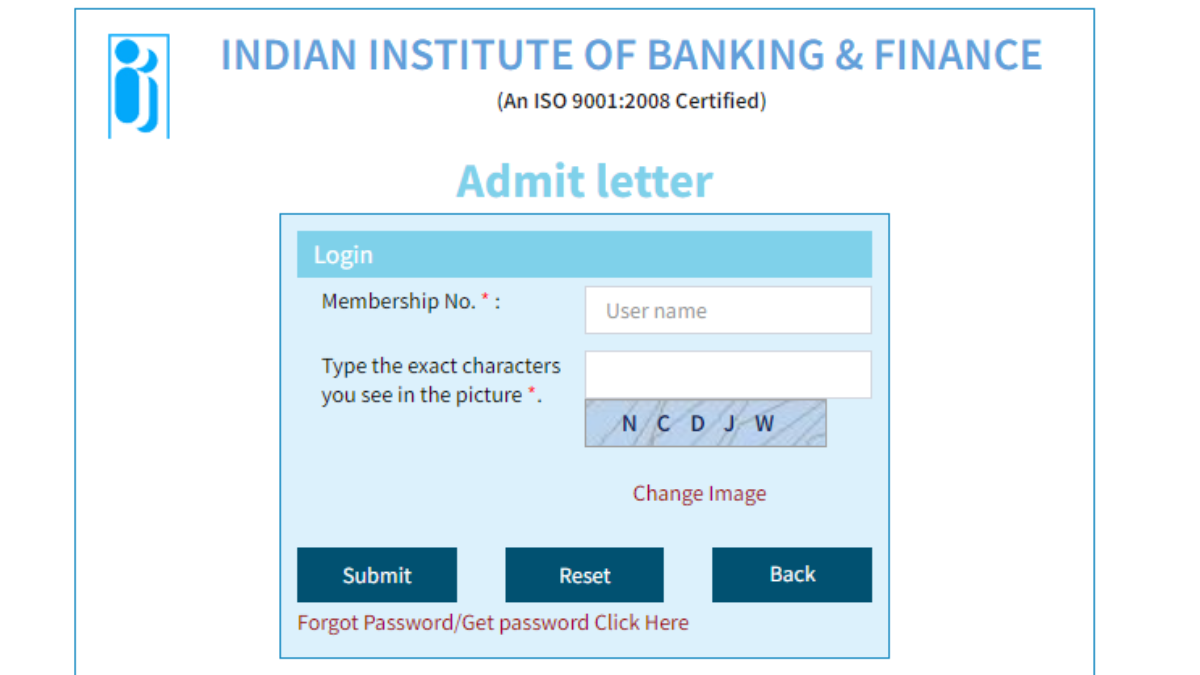
The IIBF has released the JAIIB Admit Card 2026 on its official website. Candidates can download their hall ticket by logging in with their membership or registration number. It is important to carry the admit card to the exam hall, as entry will not be allowed without it. For convenience, a direct link to download the call letter is given below.

JAIIB Admit Card 2026 – Download Link

Home_5.1

Steps to Download JAIIB Call Letter 2026

Candidates appearing for the exam can easily download their JAIIB Call Letter 2026 from the official website of the Indian Institute of Banking and Finance by following a few simple steps. Make sure to keep your login credentials ready before starting the process.

  • Go to the official IIBF website – iibf.org.in.
  • Find and click on the JAIIB Admit Card 2026 (May Session) link.
  • Enter your membership or registration number.
  • Complete the captcha verification.
  • Click on the Submit button.
  • Your hall ticket will be displayed on the screen.
  • Download and print the admit card for the exam day.

Details Mentioned on JAIIB Admit Card 2026

Candidates appearing for the JAIIB  Exam 2026 must carefully review all the details mentioned on their admit card to ensure there are no discrepancies. Verifying the information in advance helps avoid any last-minute issues at the examination centre. In case of any error, candidates should immediately contact the concerned authorities for correction. The JAIIB Admit Card 2026 will include the following details:

  • Candidate’s Name
  • Membership/Registration Number
  • Examination Date
  • Reporting Time
  • Exam Timing
  • Exam Centre Address
  • Shift Details
  • Candidate’s Photograph and Signature
  • Important Instructions for the Examination

JAIIB Exam Date 2026

The JAIIB May 2026 exams are scheduled across multiple dates, covering all four subjects.

JAIIB Exam Date 2026
Subject Exam Date
Indian Economy & Indian Financial System (IE & IFS) 3rd May 2026
Principles & Practices of Banking (PPB) 9th May 2026
Accounting & Financial Management for Bankers (AFM) 10th May 2026
Retail Banking & Wealth Management (RBWM) 17th May 2026

JAIIB Centre Change

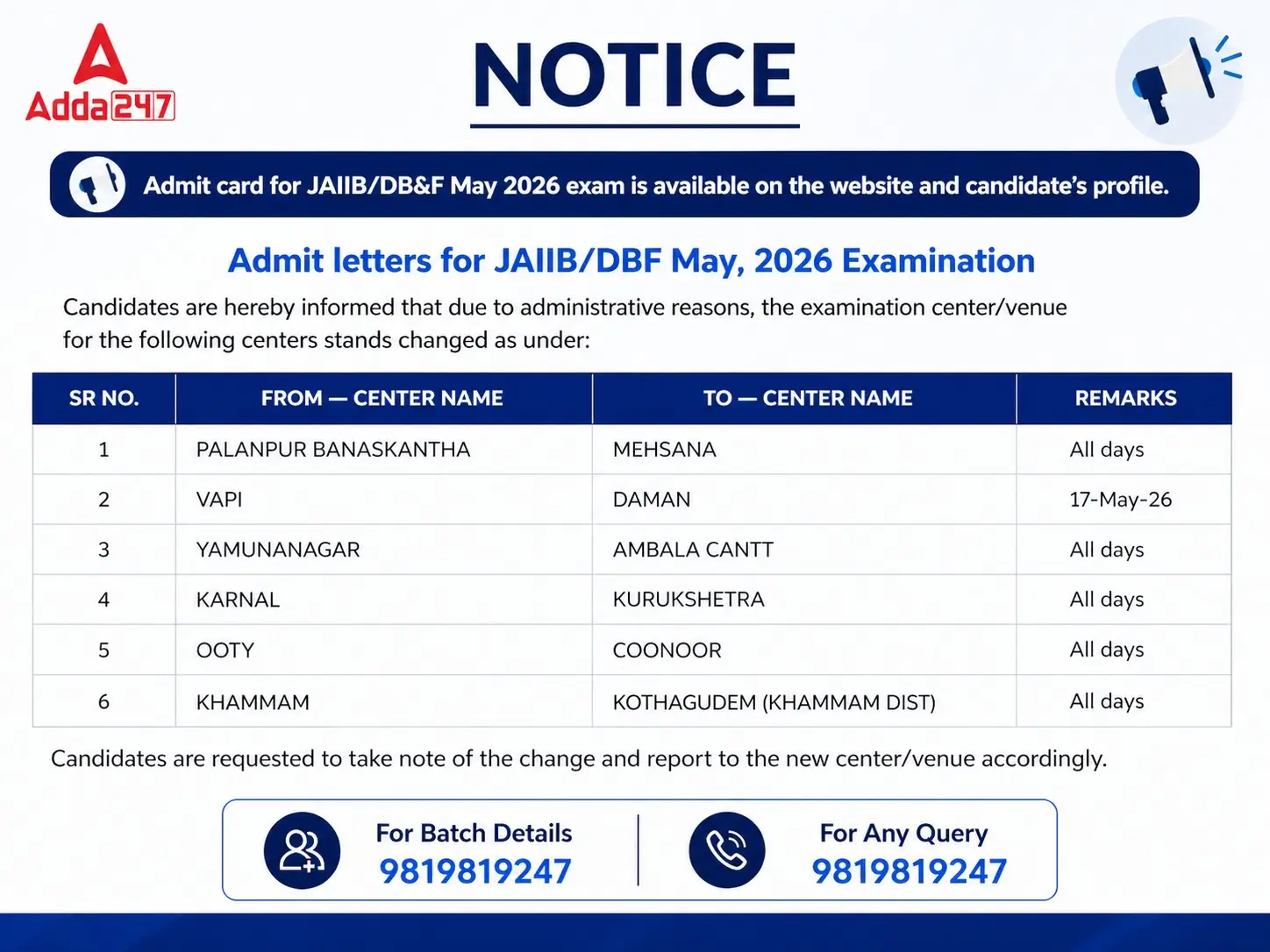
The notice informs candidates appearing for the JAIIB/DBF May 2026 examination that certain exam centres have been changed due to administrative reasons. Candidates must carefully check the updated centre details and ensure they report to the revised venue mentioned against their original centre.

From – Centre Name To – Centre Name For which day
Palanpur Banaskantha Mehsana All days
Vapi Daman 17-May-26
Yamunanagar Ambala Cantt All days
Karnal Kurukshetra All days
Ooty Coonoor All days
Khammam Kothagudem (Khammam Dist) All days

Home_6.1

JAIIB Reporting & Exam Time

The JAIIB Exam 2026 will be conducted in multiple shifts, and candidates must strictly follow the reporting time and entry schedule mentioned for their respective batch. Reaching the exam centre on time is crucial, as late entry is not allowed once the gate is closed.

Activity Shift 1 Shift 2 Shift 3
Reporting Time 8:00 AM 10:45 AM 1:30 PM
Gate Closing 8:15 AM 11:00 AM 1:45 PM
Login Start Time for Sample Test 8:20 AM 11:05 AM 1:50 PM
Exam Start Time 8:30 AM 11:15 AM 2:00 PM
Exam Close Time 10:30 AM 1:15 PM 4:00 PM


Related Posts
JAIIB Syllabus
JAIIB Salary JAIIB Study Material 2026
JAIIB Previous Year Papers JAIIB Exam Preparation Tips 2026
JAIIB Mock Test JAIIB Online Course

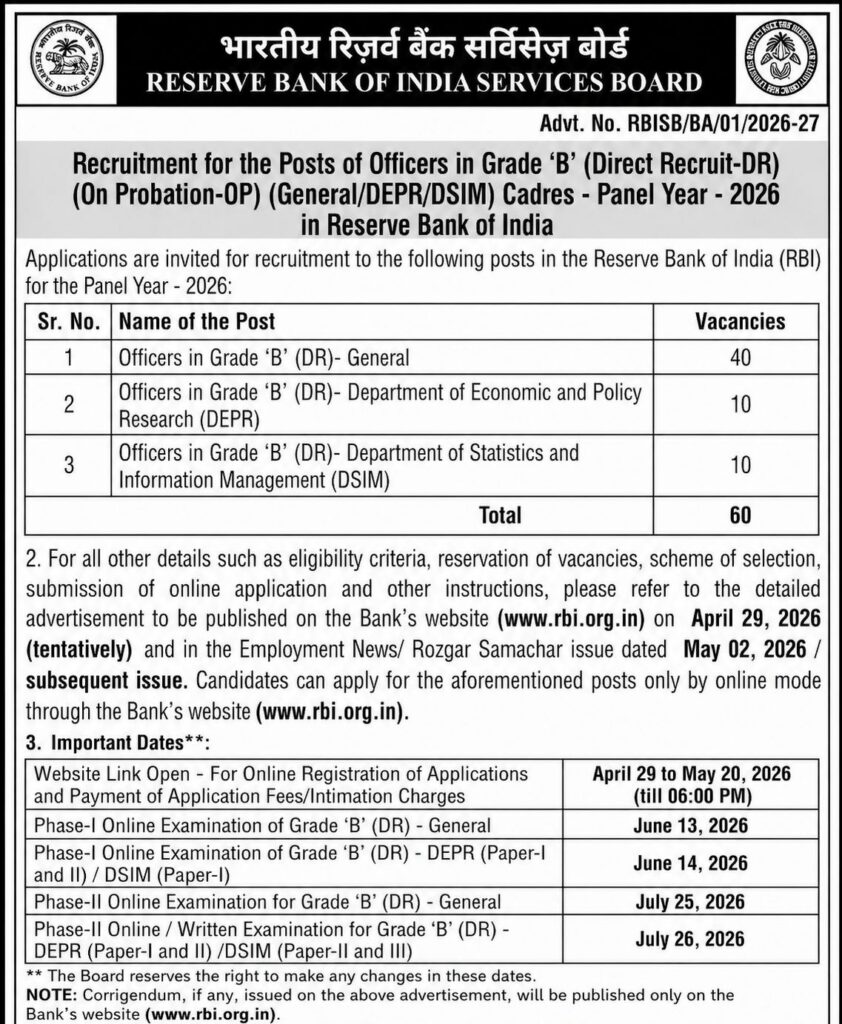
RBI Grade B Notification 2026 Out For 60 Posts, Online Registration Starts From 29 April at rbi.org.in

The Reserve Bank of India Services Board (RBISB) has officially released the much awaited RBI Grade B Notification 2026 through its newspaper advertisement for recruitment to the posts of Officers in Grade ‘B’ (Direct Recruit) under General, DEPR, and DSIM cadres. This year, the RBI has announced a total of 60 vacancies, with the online application starting from 29 April 2026.

RBI Grade B Notification 2026 Out

Here’s everything you need to know about the RBI Grade B 2026 recruitment drive.

Particulars Details
Conducting Body Reserve Bank of India (RBI)
Post Name Officer in Grade B
Streams General, DEPR, DSIM
Notification Release Date 28 April 2026 (Newspaper Advertisement Released)
Detailed PDF Expected 29 April 2026
Posts 60
Application Mode Online only – opportunities.rbi.org.in
Age Limit 21 to 30 years (General)
Educational Qualification Graduation with minimum 60% marks
Application Fee ₹850 + 18% GST (General/OBC/EWS)
Basic Pay ₹78,450/month
Gross Monthly Salary ~₹1,50,374/month
Selection Process Phase I (Prelims) → Phase II (Mains) → Interview
Official Website www.rbi.org.in

RBI Grade B 2026 Important Dates

The RBI Services Board has provided a clear calendar for the 2026 recruitment cycle. Mark these dates on your calendar. The Board has noted that it reserves the right to make changes to these dates, so candidates are advised to keep checking the official RBI website for any updates or corrigendum.

Events Dates
Newspaper Advertisement Released 28 April 2026
Detailed Notification PDF 29 April 2026
Online Application Start Date 29 April 2026
Last Date to Apply Online 20 May 2026
Phase I (Prelims) Exam Date 13 June 2026
Phase II (Mains) Exam Date 25 July 2026
Interview After Phase II result

RBI Grade B Notification 2026 PDF

According to the newspaper advertisement, the detailed notification including complete eligibility criteria, vacancy reservation, scheme of selection, and step-by-step application instructions is going to be published on the official website. Candidates are strongly advised to read the detailed notification thoroughly before filling the application form to avoid any errors.

RBI Grade B Notification 2026

Are You Preparing For RBI Grade B 2026???

RBI Grade B Vacancy 2026

The Reserve Bank of India has announced 60 Vacancies distributed across three streams. Here’s the breakdown as per the official advertisement:

Sr No. Name of the Post Vacancies
1. Officers in Grade ‘B’ (DR) – General 40
2. Officers in Grade ‘B’ (DR) – Department of Economic and Policy Research (DEPR) 10
3. Officers in Grade ‘B’ (DR) – Department of Statistics and Information Management (DSIM) 10
Total 60

It is worth noting that the 2026 vacancy count of 60 is significantly lower than the 120 vacancies released in 2025, making the competition tighter this year.

RBI Grade B Vacancy Trend Last Years

Year General DEPR DSIM Total Vacancies
2026 40 10 10 60
2025 83 17 20 120
2024 66 21 07 94
2023 222 38 31 291
2022 238 31 25 294

RBI Grade B 2026

RBI Grade B 2026 Eligibility Criteria

Before applying for the RBI Grade B 2026, candidates must carefully understand the eligibility requirements laid down by the Reserve Bank of India. The eligibility criteria mainly revolve around educational qualifications and age limits, with additional requirements for specialized posts.

1. Educational Qualification

Post Core Qualification Marks Requirement Additional Acceptable Qualifications
General Graduation in any discipline OR Post-Graduation 60% (Gen) / 50% (SC/ST/PwBD)
PG: 55% (Gen) / Pass (Reserved)
• 3-year professional course (post-Class XII)
• CA (ICAI) qualification
• 2-year PG equivalent course
DEPR Master’s in Economics / Finance / Related Fields OR MBA/PGDM (Finance) 55% (Gen) / 50% (SC/ST/PwBD) • Specializations like Econometrics, Development Economics etc.
• Teaching/Research experience (Age relaxation benefit)
DSIM Master’s in Statistics / Maths / Econometrics OR Related Fields 55% (Gen) / 50% (SC/ST/PwBD) • M.Stat from ISI
• PGDBA (ISI + IIT + IIM)
• Maths + PG Diploma in Statistics
  • Final year students are NOT eligible. Results must be officially declared on or before the notification date.
  • CA (ICAI) qualification is also accepted for the General post.
  • A full-time graduation course of at least 3 years after Class 12 from a recognized university is mandatory.

2. Age Limit

Category Age Limit Relaxation
General 21 – 30 years
OBC (NCL) 21 – 33 years +3
SC/ST 21 – 35 years +5
PwBD Up to 40 years +10
M.Phil Up to 32 years +2
PhD Up to 34 years +4

3. Nationality

Must be a citizen of India. Candidates of Indian origin who have migrated from certain specified countries may also be eligible refer to official notification for details.

4. Number of Attempts

The number of attempts for RBI Grade B is regulated by the Reserve Bank of India and varies based on the candidate’s category.

Category Number of Attempts Allowed
General 6 attempts
OBC (NCL) 9 attempts
SC/ST No limit
PwBD No limit (as per category rules)

RBI Grade B Notification 2026 Application Fee

Before submitting the form for RBI Grade B 2026, candidates should be aware of the application charges set by the Reserve Bank of India. The fee differs based on category, as shown below:

  • An additional 18% GST is applicable on the above fees.
  • Payment must be made through online mode only.
  • Fee once paid is non-refundable.
Category Application Fee Total Payable (Incl. GST)
General / OBC / EWS ₹850/- ₹1,003/-
SC / ST / PwBD ₹100/- ₹118/-

RBI Grade B Notification 2026 Apply Online Link

The application window will get active from 29 April to 20 May, during which applicants must complete their registration by entering basic details, uploading required documents, and filling in their academic and personal information accurately.

RBI Grade B Apply Online 2026 (To Be Active on 29 April)

RBI Grade B Salary

The RBI Grade B salary is among the most attractive packages offered by any government institution in India. Below we have given the complete salary breakdown:

Component Details
Basic Salary ₹78,450/-
Dearness Allowance, Special Allowance, Grade Allowance As per rules
House Rent Allowance
15% of Basic (if no accommodation)
Total Salary (Approx.)
₹1,50,374/- (without HRA)
Pay Scale ₹78,450 – ₹1,41,600 (over 16 years)

Additional Benefits & Perks

  • Accommodation: Staff Quarters provided at major RBI offices (or HRA at 15% of basic pay)
  • Medical: Full medical coverage for employee + family under RBI Medical Scheme
  • Conveyance Allowance + Telephone Allowance + Family Allowance
  • Pension: Defined Benefit Pension Scheme (one of very few institutions still offering this)
  • Loans: Concessional interest rate on home loan, car loan, personal loan
  • Leave Fare Concession (LFC) / Leave Travel Concession (LTC)
  • Children’s Education Allowance
  • Club membership + staff welfare facilities

RBI Grade B 2026 Exam Pattern

The RBI Grade B Exam Pattern 2026 outlines the structure of the examination across different streams. It includes objective and descriptive papers designed to assess candidates’ aptitude, subject knowledge, and analytical ability in a systematic manner.

Phase I

Stream Phase Paper/Section Questions Marks Duration
General (DR) Phase I English Language 30 30 25 mins
General Awareness 80 80 25 mins
Quantitative Aptitude 30 30 25 mins
Reasoning 60 60 45 mins
Total 200 200 120 mins
DEPR Phase I Paper I (Economics) 100 120 mins
Paper II (English, Descriptive) 100 120 mins
DSIM Phase I Paper I (Statistics) 100 120 mins

Phase II (General)

Paper Type Marks Duration
Paper I: Economic & Social Issues (ESI) Objective + Descriptive 100 120 min
Paper II: English (Writing Skills) Descriptive 100 90 min
Paper III: Finance & Management Objective + Descriptive 100 120 min
Total 300 5 Hours 30 Minutes

Interview

Stage Marks
Personal Interview 75

Phase II (DEPR)

Paper Type Marks Duration
Paper I Descriptive Type (Economics) 100 120 min
Paper II Descriptive Type (Economics) 100 120 min
Total 300 200 4 Hours

Interview

Stage Marks
Personal Interview 75

Phase II (DSIM)

Paper Type Marks Duration
Paper II  Descriptive Type (Statistics) 100 180 min
Paper III English – Descriptive 200 90 min
Total 300 4 Hours 30 min

Interview

Stage Marks
Personal Interview 75

RBI Grade B Selection Process 2026

The RBI Grade B selection process is designed to test both conceptual understanding and decision-making ability.

Stage Details
Phase 1 (Prelims) Objective exam – Tests Reasoning, Quant, English & General Awareness
Phase 2 (Mains)
Descriptive + Objective – Includes ESI, FM & English (Writing Skills)
Interview
Final round to assess personality, knowledge & suitability

Daily Current Affairs Quiz 28th April 2026 for Banking & Competitive Exams

Daily Current Affairs: 28th April, 2026

Q1. The Government of India has launched a five-year project (2025–2030) titled ‘Strengthening Institutional Capacities for Securing Biodiversity Conservation Commitments’. Which of the following sets of international organizations is providing technical and financial support for this initiative in partnership with the MoEFCC and the National Biodiversity Authority (NBA)?

(a) World Bank and the International Union for Conservation of Nature (IUCN)

(b) Global Environment Facility (GEF) and the United Nations Development Programme (UNDP)

(c) Asian Development Bank (ADB) and the United Nations Environment Programme (UNEP)

(d) New Development Bank (NDB) and the World Wide Fund for Nature (WWF)

(e) Green Climate Fund (GCF) and the Food and Agriculture Organization (FAO)

Answer: b

Solution:

  • The Ministry of Environment, Forest and Climate Change and the National Biodiversity Authority have launched a five-year project (2025–2030) titled “Strengthening Institutional Capacities for Securing Biodiversity Conservation Commitments.”
  • The project is a joint initiative of the Government of India, the Global Environment Facility, and the United Nations Development Programme, with funding support of USD 4.88 million.
  • The initiative aims to strengthen grassroots biodiversity governance by integrating biodiversity into Gram Panchayat Development Plans (GPDPs).
  • It focuses on empowering local communities, Panchayati Raj Institutions (PRIs), and Biodiversity Management Committees (BMCs).
  • The project is being implemented in two key ecological landscapes:
    • In Tamil Nadu: the Sathyamangalam landscape, including Mudumalai Tiger Reserve and Sathyamangalam Tiger Reserve.
    • In Meghalaya: the Garo Hills region, covering Nokrek Biosphere Reserve, Balpakram National Park, and Siju Wildlife Sanctuary.
  • A major objective is to mainstream biodiversity into local development planning, creating community-driven conservation strategies.
  • The project also promotes innovative financing mechanisms, including:
    • Access and Benefit Sharing (ABS)
    • CSR-based co-financing
    • Green micro-enterprises for sustainable livelihoods
  • Another key focus is capacity building and knowledge management, ensuring replication of best practices across the country.

Q2. In April 2026, the Union Minister of Housing and Urban Affairs, Sh. Manohar Lal Khattar, released a landmark report titled “Moving Towards Effective City Government – A Framework for Million-plus Cities.” Which of the following organizations prepared this comprehensive report?

(a) Ministry of Housing and Urban Affairs (MoHUA)

(b) Finance Commission of India

(c) NITI Aayog (National Institution for Transforming India)

(d) National Institute of Urban Affairs (NIUA)

(e) Quality Council of India (QCI)

Answer: c

Solution:

  • Manohar Lal Khattar, Union Minister of Housing & Urban Affairs, released the report “Moving Towards Effective City Government – A Framework for Million-plus Cities”.
  • The report has been prepared by NITI Aayog.
  • It was released on 25 April 2026 at India Habitat Centre, New Delhi.
  • The report provides a roadmap for strengthening governance in India’s million-plus cities, which are key drivers of economic growth.
  • It emphasises the need to strengthen institutional frameworks along with sectoral improvements in urban governance.

Q3. International Design Day is observed globally on April 27 to mark the anniversary of the International Council of Design (ICoD) and to highlight the capacity of design to effect social change. What is the official theme for International Design Day 2026?

(a) Design for a Sustainable World

(b) The spaces in between

(c) Bridging the Gap: Design for All

(d) Designing for the Future

(e) Design in the Digital Era

Answer: b

Solution:

  • International Design Day is celebrated every year on 27 April worldwide.
  • The day commemorates the founding of the International Council of Design on 27 April 1963.
  • The observance was earlier known as World Design Day until 2020.
  • It highlights the importance of design and its role in driving innovation and positive change.
  • The theme for 2026 is “The Spaces in Between.”

Q4. Raghu Rai, who passed away in April 2026, was a legendary figure in which of the following fields?

(a) Classical Music

(b) Photojournalism

(c) Architecture

(d) Archaeology

(e) Sculpture artist

Answer: b

Solution

  • Raghu Rai, legendary Indian photographer, passed away on 26 April 2026 in New Delhi.
  • He was 83 years old and had been battling cancer for two years.
  • Born on 18 December 1942 in Jhang, he became one of the most renowned photographers globally.
  • Often referred to as the “father of Indian photography/photojournalism,” he documented India’s social, political, and cultural landscape for over six decades.
  • He was mentored by Henri Cartier-Bresson and joined the prestigious Magnum Photos in 1977.
  • His work includes iconic coverage of the Bhopal Gas Tragedy, which brought global attention to the disaster.
  • He also captured defining moments such as the Bangladesh Liberation War, along with portraits of Indira Gandhi and Mother Teresa.
  • His work was published in leading global publications like Time, Life, The New York Times, and The New Yorker, and he authored over 18 books.
  • He was awarded the Padma Shri in 1972.
  • Other honours include Photographer of the Year (1992, USA), Académie des Beaux-Arts Photography Award (2019), and a Lifetime Achievement Award (2017) by the Ministry of Information & Broadcasting.

Q5. In April 2026, which Middle Eastern nation became the 63rd country to sign the Artemis Accords at NASA Headquarters?

(a) Saudi Arabia

(b) Qatar

(c) Kuwait

(d) Egypt

(e) Jordan

Answer: e

Solution:

  • In April 2026, Jordan signed the Artemis Accords at the headquarters of National Aeronautics and Space Administration.
  • With this, Jordan became the 63rd signatory to the Artemis Accords.

About Artemis Accords:

  • The Artemis Accords were launched in 2020.
  • They are a non-binding set of principles aimed at guiding civil space exploration and cooperation.
  • The framework was co-led by NASA and the U.S. Department of State, along with founding members including Australia, Canada, Italy, Japan, Luxembourg, UAE, and the United Kingdom.
  • India is also a signatory to the accords.

Q6. How many total medals did the Indian contingent win at the ISSF Junior World Cup 2026 in Cairo?

(a) 12

(b) 14

(c) 16

(d) 18

(e) 20

Answer: c

Solution:

  • Indian shooters delivered an outstanding performance at the ISSF Junior World Cup 2026.
  • The tournament was held in Cairo, Egypt.
  • India finished at the top of the medal standings.
  • India secured a total of 16 medals, comprising:
    • 5 Gold medals
    • 6 Silver medals
    • 5 Bronze medals

Q7. In April 2026, Himadri Speciality Chemical Limited (HSCL) commissioned India’s first production facility for which critical lithium-ion battery component?

(a) Cathode Active Material

(b) Anode Material

(c) Solid-state Electrolyte

(d) Polypropylene Separator

(e) Aluminum Foil Current Collector

Answer: b

Solution:

  • In April 2026, Himadri Speciality Chemical Limited commissioned India’s first anode material production facility.
  • The facility has an initial capacity of 200 Metric Tonnes Per Annum (MTPA).
  • It is located at Hooghly, West Bengal (Mahistikry).
  • Himadri Speciality Chemical Limited is India’s largest speciality carbon black producer.

Q8. The Delhi Metro Rail Corporation (DMRC) appointed the first-ever CEO of its international subsidiary, DMIL. Who has been appointed to this position?

(a) Sanjay Jamuar

(b) Vikas Kumar

(c) Mangu Singh

(d) E. Sreedharan

(e) Vinay Kumar Tripathi

Answer: a

Solution:

  • The Delhi Metro Rail Corporation announced the appointment of Sanjay Jamuar as the first Chief Executive Officer (CEO) of Delhi Metro International Limited.
  • Sanjay Jamuar is a former officer of the Indian Railway Traffic Service (IRTS).
  • The appointment marks a significant step in strengthening DMRC’s international operations and consultancy services.
  • Delhi Metro International Limited has been set up to expand Delhi Metro’s global footprint in metro rail projects.

Q9. Shri Dinesh Trivedi has been appointed as the next High Commissioner of India to which of the following neighbouring countries in April, 2026?

(a) Sri Lanka

(b) Nepal

(c) Bangladesh

(d) Bhutan

(e) Maldives

Answer: c

Solution:

  • Dinesh Trivedi has been appointed as the next High Commissioner of India to Bangladesh.
  • The appointment marks a key diplomatic development in India–Bangladesh relations.

Q10. In April 2026, Visa announced the appointment of a new Group Country Manager for India and South Asia. Who among the following has been chosen for this role?

(a) Sandeep Ghosh

(b) Suresh Sethi

(c) TR Ramachandran

(d) Dilip Asbe

(e) Rishi Gupta

Answer: b

Solution:

  • Visa has appointed Suresh Sethi as its Group Country Manager for India and South Asia.
  • In this role, Suresh Sethi will oversee strategy and operations across six countries in the region.
  • He previously served as the head of Protean eGov Technologies Ltd.

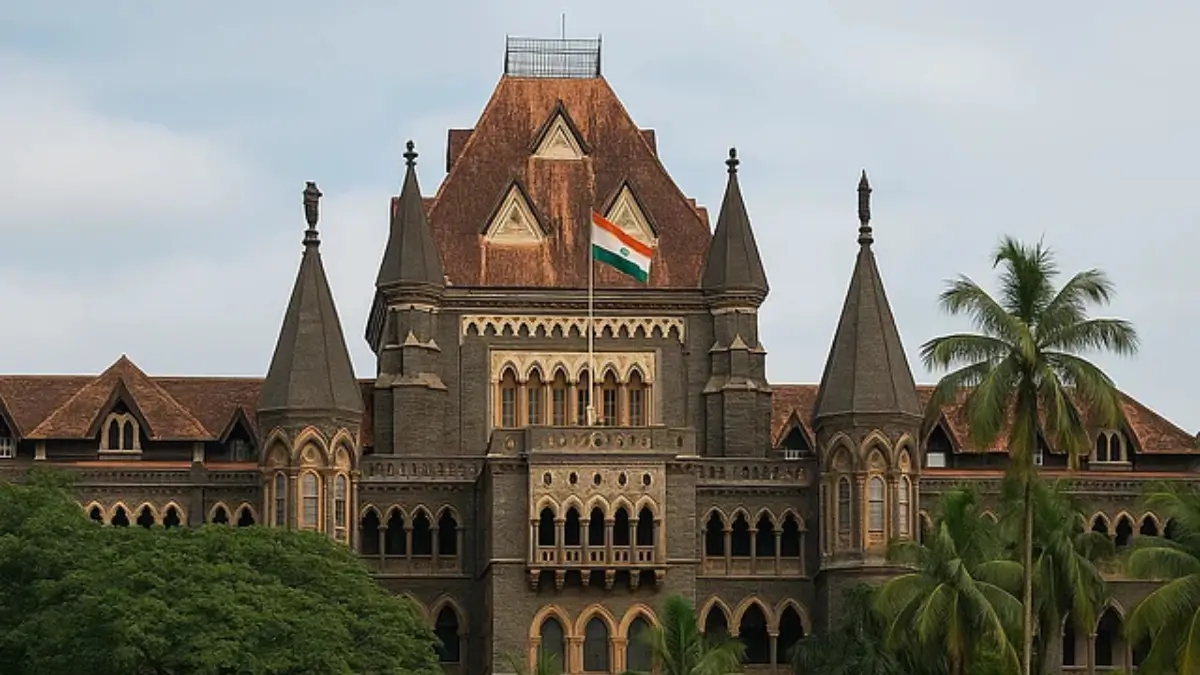
Bombay High Court Answer Key 2026 Out, Download Clerk & Driver Response Sheet PDF

The Bombay High Court Answer Key 2026 has been officially released for the Clerk and Driver recruitment examination, bringing clarity for candidates who appeared in the exam conducted on 26 April 2026. Released by the Bombay High Court, the answer key allows candidates to check their responses, estimate scores, and evaluate their chances of selection. With a massive 2306 vacancies announced, this recruitment has seen high competition, making the answer key an important tool for performance analysis.

Bombay High Court Answer Key 2026 Out

The answer key has been made available in PDF format for both Clerk and Driver posts. Candidates can download the response sheet and compare their answers with the official key to calculate their expected marks. Candidates also have the opportunity to raise objections within the specified timeline if they find discrepancies. Candidates should carefully review the answer key and note any discrepancies before submitting objections.

Bombay High Court Answer Key 2026 Download Link

Candidates can download the answer key from the official website of the Bombay High Court. The response sheet is available under the recruitment section and can be accessed without logging in.

Bombay High Court Answer Key 2026 (Clerk): Download PDF

Bombay High Court Answer Key 2026 (Driver): Download PDF

Steps to Download Answer Key

  • Visit the official website
  • Go to the “Recruitment” section
  • Click on “Clerk & Driver Answer Key 2026”
  • Download the PDF file
  • Match your responses with the official answers

Test Prime

How to Raise Objections Against the Answer Key

Candidates who find any incorrect answers in the official key can raise objections within the given deadline. Proper justification and valid proof are required for each objection.

  • Last Date to Raise Objection: 30 April 2026
  • Email ID: recruitemnt@bhc.gov.in
  • Mention the question number and the correct answer with proof
  • Submit objections within the deadline only

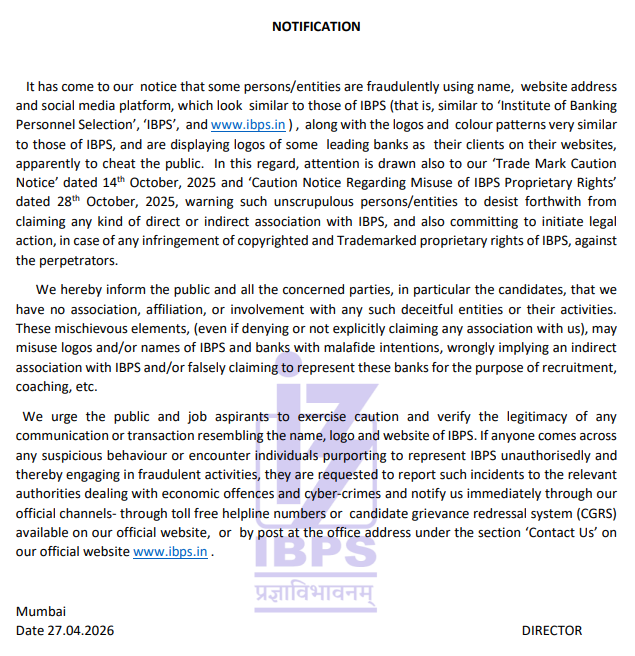
IBPS Fraud Alert 2026: Official Warning Against Fake Website and Logos

The IBPS Fraud Alert 2026 has been officially issued to warn candidates and the general public about fraudulent websites and misuse of the IBPS name, logo, and branding. Released by the Institute of Banking Personnel Selection on 27 April 2026, this notice highlights the growing number of fake platforms impersonating IBPS to mislead aspirants. With online scams increasing in the recruitment space, this alert is a crucial step to safeguard candidates from financial and data-related fraud.

IBPS Fraud Alert 2026

As per the official notification, IBPS has observed that certain individuals and entities are creating fake websites and social media platforms that closely resemble the official IBPS website. These platforms use similar names, logos, and even color schemes to appear authentic and deceive candidates.

  • Fake websites mimicking IBPS (e.g., similar to www.ibps.in)
  • Unauthorized use of IBPS name, logo, and branding
  • Display of leading bank logos falsely claiming association
  • Misleading candidates regarding recruitment or coaching services

Home_14.1

IBPS: No Association with Fake Entities

IBPS has clearly stated that it has no connection or affiliation with any such fraudulent websites, platforms, or individuals. The organization has emphasized that these entities are acting independently with malicious intent.

  • No official partnership with such platforms
  • No authorization given for recruitment or coaching through third parties
  • Any claim of association with IBPS is false

Legal Action Against Fraudulent Activities

IBPS has also warned that strict legal action will be taken against those misusing its trademark, copyright, and proprietary rights. The organization has previously issued caution notices in October 2025 regarding such misuse.

  • Legal action against copyright and trademark violations
  • Warning issued to fraudsters to stop misuse immediately
  • Protection of IBPS brand and candidate interests

How Candidates Can Stay Safe

Candidates must take proactive steps to verify the authenticity of any information related to IBPS recruitment. Being cautious can prevent financial loss and data misuse.

  • Always visit the official website: www.ibps.in
  • Avoid clicking on suspicious links or unknown portals
  • Do not share personal or banking details on unofficial platforms
  • Verify notifications through official IBPS channels
  • Be cautious of offers related to guaranteed selection or paid services

Reporting Fraudulent Activities

IBPS has urged candidates to report any suspicious activity or fraudulent behaviour immediately. Timely reporting can help prevent further scams and protect other aspirants.

  • Report to the cybercrime or economic offence authorities
  • Inform IBPS through the official helpline or CGRS
  • Use the “Contact Us” section on the official website

Why IBPS Fraud Alert is Important

This fraud alert is highly significant as it directly impacts thousands of banking aspirants across the country. With increasing digital scams, such warnings help candidates stay informed and cautious.

  • Protects candidates from financial fraud
  • Ensures trust in the official recruitment process
  • Promotes awareness about cyber safety
  • Prevents misuse of the IBPS brand name

Test Prime

JAIIB Exam Date 2026, Syllabus, Exam Pattern, Eligibility & Important Details

The JAIIB Exam Date 2026 has been announced, with the examination scheduled to begin from 03 May 2026, and the admit card has already been released for registered candidates. Conducted by the Indian Institute of Banking and Finance, the JAIIB exam is a key certification for banking professionals aiming to enhance their knowledge and career growth. With the exam approaching, candidates should stay updated with the syllabus, exam pattern, and eligibility criteria to ensure effective preparation

JAIIB Exam Date 2026

The JAIIB Exam Date 2026 for the May and November sessions includes multiple papers conducted across different days. Candidates should carefully go through the complete schedule of all subjects to plan their preparation and revision effectively. As the exam is conducted in multiple papers, it becomes important to allocate time wisely for each subject and focus on regular practice.

The exam will be held in multiple cycles, including May and November, with subject-wise dates already notified.

Subject May 2026 November 2026
Indian Economy & Indian Financial System (IE & IFS) 3rd May 2026
1st November 2026
Principles & Practices of Banking (PPB) 9th May 2026
22nd November 2026
Accounting & Financial Management for Bankers (AFM) 10th May 2026
28th November 2026
Retail Banking & Wealth Management (RBWM) 17th May 2026
29th November 2026

JAIIB Exam 2026: Summary

The JAIIB qualification is widely valued for strengthening long-term career prospects in banking. As per the latest update, the JAIIB Exam Date 2026 has now been officially released. The examination is scheduled to be conducted in May and November 2026. Below is a quick summary of the exam details.

Particulars Details
Exam Name Junior Associate of the Indian Institute of Bankers (JAIIB)
Conducting Body Indian Institute of Banking and Finance (IIBF)
Type of Course Flagship
Eligibility Members of IIBF and 12th standard pass in any discipline
Exam Frequency Conducted twice a year
Mode of Application Online
Mode of Examination Online
Language of Exam English / Hindi
Subjects Indian Economy & Indian Financial System (IE & IFS)
Principles & Practices of Banking (PPB)
Accounting & Financial Management for Bankers (AFM)
Retail Banking & Wealth Management (RBWM)
Qualifying Marks 50 out of 100
Time Limit 3 years or 5 attempts
JAIIB Admit Card 2026 27th April 2026
Official Website www.iibf.org.in

What is IIBF Exams?

IIBF offers a wide range of exams designed to enhance the skills and knowledge of banking and finance professionals. These exams are structured across different categories, including flagship courses, diploma programs, blended courses, and certifications, each catering to specific areas of expertise.

  • Flagship courses: The IIBF Exams under this course are JAIIB, CAIIB, CAIIB Elective Subjects as a Separate Certificate Examination, Diploma in Banking & Finance
  • Diploma Courses: The IIBF Exams under this course are Diploma in Banking Technology, Diploma in Treasury Investment & Risk Management, Diploma in International Banking & Finance, Diploma in Commodity Derivatives for Bankers, Advanced Wealth Management, Diploma in Home Loan Advising, Diploma in Retail Banking, Urban Co-Operative Banking
  • Blended Courses: IIBF also conducts exams for the blended courses it offers, such as Bank Trainers, Compliance Professional, Credit Professional, Treasury Professional, Risk & Financial Services, and Certified Accounting & Audit Professional
  • Certifications: Some IIBF Exams are meant for certification purposes only. Do check the website for these certifications

IIBF (Indian Institute of Banking and Finance)

The JAIIB Exam 2026 is conducted twice a year, in May and November, for members of the Indian Institute of Banking and Finance working in banks and financial institutions. Qualifying the exam helps candidates strengthen their understanding of key banking concepts and gain benefits such as promotions and salary increments.

JAIIB Full Form

JAIIB stands for Junior Associate of the Indian Institute of Bankers. It is a certification course offered by the Indian Institute of Banking and Finance (IIBF). The goal of this course is to help banking professionals understand the basics of banking operations, financial management, and customer service. Earning the JAIIB certificate improves knowledge and skills and can lead to better job opportunities, promotions, and higher pay in the banking sector. 

JAIIB 2026 Eligibility Criteria

To apply for JAIIB 2026, candidates must meet the following criteria:

  • IIBF Membership: Candidates must be regular members of the Indian Institute of Banking and Finance, which is mandatory to register for the exam.
  • Educational Qualification: Applicants should have successfully completed 12th standard or an equivalent qualification recognized by the education board.
  • Clerical/Supervisory Staff: Clerical and supervisory employees of banks and financial institutions can apply, provided they have a recommendation or endorsement from their immediate manager.
  • Subordinate Staff: Subordinate or support staff are eligible if they are IIBF members and have passed the 12th standard, ensuring a minimum educational requirement is met.

IIBF JAIIB Exam 2026 Subjects

The JAIIB (Junior Associate of the Indian Institute of Bankers) May Exam 2026 consists of four compulsory papers. Candidates must pass all four papers to obtain the JAIIB certification. Each paper tests different banking and financial concepts important for banking professionals.

List of JAIIB Subjects 2026

  • Paper 1: Indian Economy and Indian Financial System (IE & IFS)
  • Paper 2: Principles and Practices of Banking (PPB)
  • Paper 3: Accounting and Financial Management for Bankers (AFM)
  • Paper 4: Retail Banking and Wealth Management (RBWM)

JAIIB 2026 Exam Pattern

The JAIIB 2026 Exam Pattern outlines the structure of the examination, including the number of papers, total questions, marks, and duration for each subject. Understanding the exam pattern in advance helps candidates plan their preparation and manage time efficiently during the actual examination.

Paper Name No. of Questions Total Marks Exam Duration
Indian Economy & Indian Financial System (IE & IFS) 100 100 2 Hours
Principles & Practices of Banking (PPB) 100 100 2 Hours
Accounting & Financial Management for Bankers (AFM) 100 100 2 Hours
Retail Banking & Wealth Management (RBWM) 100 100 2 Hours

Passing Criteria for JAIIB Exam 2026

To successfully clear the JAIIB Exam 2026, candidates must meet the following requirements:

  • Minimum Marks per Paper: Candidates need to score at least 50 marks out of 100 in each of the four papers to be considered as having passed.
  • Relaxation for Aggregate Score: A candidate who scores a minimum of 45 marks in each subject and achieves an overall aggregate of 50% in a single attempt may also be considered qualified.
  • Credit Retention: Once a paper is cleared, the marks obtained are retained for future attempts until the maximum allowed time period or attempts are exhausted.
  • Attempt Limit and Time Frame: Candidates can appear for the JAIIB exam a maximum of 5 times within 3 years from the date of first registration. Planning attempts strategically is important to ensure all subjects are cleared within the allowed timeframe.
  • Validity of Passing: The passing status of each paper remains valid for the entire eligibility period, allowing candidates to focus on the remaining papers without losing credit for already cleared subjects.

Medium of JAIIB Exam

Candidates can choose the medium of the exam at the time of registration. The exam is available in two languages:

  • English
  • Hindi

Ensure that the preferred language is selected correctly during the application process, as changes are not usually permitted after the form is submitted.

Important Instructions & Guidelines for JAIIB Exam 2026 Candidates

To have a smooth and stress-free JAIIB 2026 exam, follow these important instructions:

  • Reach the exam centre early: Arrive 30–45 minutes before the reporting time.
  • Carry essential documents: Bring your admit card, valid photo ID, and any other required papers.
  • No electronic devices: Mobile phones, calculators, smartwatches, or other gadgets are strictly prohibited.
  • Follow dress code and instructions: Wear appropriate attire and follow all rules mentioned on the admit card.
  • Check official updates: Regularly visit the IIBF website for any changes in the exam date or schedule.

JAIIB Exam 2026 Time Limit

Candidates appearing for the JAIIB May Exam 2026 have a limited number of attempts and a time frame to clear the exam. Understanding these rules helps in planning attempts strategically.

Key Points:

  • Maximum Attempts: 5 attempts to clear the exam
  • Time Limit: 3 years from the date of first registration
  • Start of Count: Begins from the first registration date
  • Non-Consecutive Attempts: Attempts do not need to be in a row
  • Counting Attempts: Even if a candidate registers but doesn’t appear, it counts as an attempt
  • Exam Opportunities: Candidates can appear in any five out of six scheduled exams within three years

JAIIB Exam 2026 Application Fees

The application fee for the JAIIB Exam entirely depends on the number of attempts of a candidate. The given table provides the JAIIB Application Fees attempt-wise.

JAIIB Exam Application Fees
S.No. Name of the Exam Attempts Application fee
1 JAIIB Exam 1st attempt Rs. 4000
2 2nd attempt Rs. 1300
3 3rd attempt Rs. 1300
4 4th attempt Rs. 1300
5 5th attempt Rs. 1300

pdpCourseImg

Best Preparation Strategy to Crack JAIIB 2026 in First Attempt

To prepare well for the JAIIB Exam 2026, start by watching YouTube videos from trusted platforms, which explain important concepts in detail.

  • Take notes while watching to make revision easier. Focus on understanding the basics of each subject, as this will help you answer questions more confidently.
  • Practice with the JAIIB Previous Year’s Questions Paper to get familiar with the exam pattern and difficulty level.
  • Make sure to take regular mock tests to improve your speed and accuracy.
  • Combine video lessons with books for better learning. Stay consistent with your study routine, and keep a positive attitude.

JAIIB 2026 Syllabus

As mentioned on the official website of IIBF, www.iibf.org.in, there are 4 compulsory papers for the JAIIB May Exam. Each of the listed down papers has been further divided module-wise.

Paper 1: Indian Economy and Indian Financial System (IE & IFS)
Paper 2: Principles and Practices of Banking (PPB)
Paper 3: Accounting and Financial Management for Bankers (AFM)
Paper 4: Retail Banking and Wealth Management (RBWM)

Check Module-Wise JAIIB Syllabus

Why JAIIB Certification Matters for Banking Professionals

Earning the JAIIB certification is more than just a credential it’s a stepping stone to becoming a confident, skilled, and recognized banking professional. Here’s how it transforms your career:

1. Master Core Banking Concepts: JAIIB equips you with practical knowledge of banking operations, financial management, and regulatory frameworks, giving you the confidence to handle complex tasks efficiently.

2. Unlock Career Growth Opportunities: Certified professionals are often first in line for promotions and higher responsibilities. JAIIB demonstrates your commitment to professional excellence, making career progression smoother.

3. Financial Recognition & Incentives: Many banks reward JAIIB holders with salary increments, allowances, or performance benefits, reflecting your enhanced expertise and contribution.

4. Boost Day-to-Day Efficiency: From customer interactions to internal operations, JAIIB knowledge helps you solve problems faster, make informed decisions, and improve service quality.

5. Stand Out Professionally: Being JAIIB-certified adds credibility and trust both with your peers and management. It signals that you are serious about skill development and professional growth.

6. Foundation for Advanced Certifications: JAIIB serves as a launchpad for CAIIB or specialized banking certifications, enabling deeper expertise and higher-level career opportunities.

Who Should Appear for JAIIB 2026?

JAIIB 2026 is suitable for banking employees who aim to upgrade their skills and achieve long-term professional growth. The exam is designed to benefit individuals at different stages of their banking careers.

Ideal candidates for JAIIB 2026 include:

  • Clerical staff planning to move to officer-level positions
  • Newly appointed officers seeking strong foundational knowledge
  • Experienced bankers aiming for structured career progression
  • Employees of public sector banks, private banks, RRBs, and cooperative banks
  • Banking professionals who want recognized certification for career and salary growth

Career Growth Opportunities After JAIIB Certification

Clearing the JAIIB Exam 2026 opens up multiple career advancement opportunities for banking professionals. It not only strengthens your knowledge of banking operations but also enhances your eligibility for promotions, salary increments, and specialized roles. Key benefits include:

  • Promotion Eligibility: JAIIB certification is often a prerequisite for promotions from clerical or officer-level positions to higher officer grades in banks.
  • Salary Increment and Incentives: Many banks offer financial incentives or additional pay for employees who have cleared JAIIB, recognizing their enhanced skills and expertise.
  • Better Understanding of Banking Operations: The certification equips professionals with in-depth knowledge of banking processes, financial management, and customer service, making them more competent in their current roles.
  • Opportunities in Specialized Departments: Clearing JAIIB makes candidates eligible for roles in treasury, credit management, retail banking, and wealth management, providing options for career diversification.
  • Enhanced Professional Recognition: Being JAIIB-certified adds credibility and recognition within the banking sector, helping professionals stand out among peers.
  • Foundation for Advanced Certifications: JAIIB serves as a stepping stone for advanced certifications like CAIIB (Certified Associate of Indian Institute of Bankers), enabling further specialization and higher-level career growth.
  • Improved Confidence and Decision-Making Skills: The knowledge gained through JAIIB prepares candidates to handle complex banking scenarios confidently and make informed decisions.

JAIIB Admit Card 2026 for May Cycle

The Indian Institute of Banking and Finance (IIBF) usually releases the JAIIB admit card approximately 10 to 15 days prior to the start of the exam. For the May 2026 cycle, with exams commencing on 3rd May 2026, candidates can expect the admit card to be accessible for download during the final week of April 2026, likely between 22nd and 25th April, via the official IIBF portal.

How Banks Reward JAIIB Qualification

JAIIB certification boosts career growth, salary, and professional recognition in banks.

Salary & Benefits

  • Increment: One additional increment in basic pay for clerks and officers.
  • Clerks: Basic pay rises ~₹1,340; in-hand salary ₹48,000–50,000 with allowances.
  • Officers: Basic pay rises ~₹2,000; in-hand salary ₹75,000–80,000.
  • Allowances & Pension: DA, HRA, TA, and pension contributions increase with basic pay.
  • Timeline: Certificate issued within 45 days; submit to HR for increment.

Promotions & Career Growth

  • Clerks: Easier promotion to PO roles.
  • Officers: Advantage for promotion to Manager and higher scales.
  • Special Roles: Eligible for Treasury, Credit, Risk, Forex, and Retail Banking.
  • Priority: Certified candidates preferred in promotions and transfers.

Professional Recognition

  • CAIIB Eligibility: JAIIB is required for advanced CAIIB certification.
  • Global Status: Eligible for Associate Chartered Banker.
  • Credibility & Job Security: Recognized as skilled and committed professional.

Bank Variations

  • PSBs & Old Private Banks: Standard increments and promotions.
  • New Private Banks: Improves appraisal and promotion chances.
  • RRBs: Benefits vary but generally recognized for salary and promotions.
Related Posts
JAIIB Salary  JAIIB Exam Study Material
JAIIB Mock Test JAIIB Online Coaching 

Daily Current Affairs and GK Updates (27th April, 2026)

State News

Justice Lisa Gill Sworn In as First Woman Chief Justice of Andhra Pradesh High Court

  • Lisa Gill was sworn in as the first woman Chief Justice of the Andhra Pradesh High Court in a historic ceremony held in Vijayawada.
  • The oath was administered by Governor S. Abdul Nazeer, marking a significant milestone for women’s representation in India’s judiciary.
  • The event included the reading of the President’s warrant and was attended by senior judges, officials, and dignitaries.
  • Chief Minister N. Chandrababu Naidu also met her and extended congratulations, highlighting the importance of the achievement.

Andhra Pradesh Launches Massive Mushroom Mission Worth ₹13,000 Crore

  • N. Chandrababu Naidu has announced the first-ever Mushroom Mission in Andhra Pradesh with an estimated investment of ₹13,000 crore to boost large-scale mushroom production and rural incomes.
  • The mission aims to produce about 67,500 tonnes annually and establish over 1.62 lakh mushroom units, positioning the state to surpass current leading producers like Bihar.
  • Focused on small farmers, SHGs, and rural women, the initiative includes subsidy support of around ₹5,184 crore to encourage self-employment and reduce financial barriers.
  • By promoting varieties like milky, paddy straw, and button mushrooms, the project also targets export growth and development of a strong agri-based value chain.

International News

Emmanuel Macron Announces Exit from Politics After 2027, Ends Speculation of Comeback

  • Emmanuel Macron has announced that he will leave politics after completing his second presidential term in 2027, marking the end of his public life.
  • Speaking during a visit to Cyprus, he stated that he does not intend to return to politics after stepping down from the Élysée Palace, ending speculation about a possible comeback.
  • Macron, who became France’s youngest president in 2017 and was re-elected in 2022, will complete the maximum two-term limit allowed under the French Constitution.
  • His presidency has been marked by major reforms, including raising the retirement age, alongside political challenges and protests, and his exit will usher in a new phase in French politics.

Business News

Sun Pharma Pursues $11.75 Billion Acquisition of Organon in Landmark Overseas Deal

  • Sun Pharmaceutical Industries has announced plans to acquire Organon & Co. for $11.75 billion in an all-cash deal, marking one of the largest overseas acquisitions by an Indian firm.
  • The deal, priced at $14 per share and expected to close by 2027 pending approvals, will significantly expand Sun Pharma’s global footprint across over 150 countries.
  • It strengthens the company’s presence in high-growth segments like women’s health and biosimilars, positioning it among the top global players in these areas.
  • With combined revenues projected at $12.4 billion, the acquisition enhances scale, diversifies offerings, and reinforces India’s growing influence in the global pharmaceutical industry.

Agreements News

India Partners with UNDP and Global Environment Facility for The Biodiversity Project

  • India’s Ministry of Environment, Forest and Climate Change and the National Biodiversity Authority have launched a five-year project (2025–2030) to strengthen grassroots biodiversity governance in Tamil Nadu and Meghalaya, with UNDP and Global Environment Facility support.
  • The initiative integrates biodiversity conservation into local planning systems, especially Gram Panchayat Development Plans, empowering communities and institutions like PRIs and BMCs.
  • Focusing on key ecological regions such as Sathyamangalam and Garo Hills, it promotes sustainable livelihoods through mechanisms like Access and Benefit Sharing and green enterprises.
  • Aligned with India’s NBSAP, NDCs, and global biodiversity targets, it links conservation with inclusive rural development.

Appointments News

DMRC Appoints Sanjay Jamuar as First CEO of Delhi Metro International Limited

  • The Delhi Metro Rail Corporation has appointed Mr. Sanjay Jamuar as the first CEO of its new subsidiary Delhi Metro International Limited.
  • This move marks DMRC’s expansion into global metro projects and urban transport consultancy.
  • DMIL is expected to focus on international collaborations, advisory services, and metro system development abroad.
  • The appointment signals a strategic push to leverage Delhi Metro’s expertise in overseas infrastructure markets.

Awards News

Botanist N. Alim Yusuf Honoured by World Wide Fund for Nature for AI-Based Conservation App

  • Botanist N. Alim Yusuf received a prestigious award from World Wide Fund for Nature for developing an AI-powered mobile app to detect invasive plant species in Kerala.
  • The app, created at Malabar Botanical Garden and Institute for Plant Sciences, identifies nearly 100 harmful species, enabling early detection and action by researchers, officials, and the public.
  • Invasive species threaten biodiversity by competing with native plants and disrupting ecosystems, especially in ecologically sensitive regions like the Western Ghats.
  • This innovation highlights how AI-driven tools can strengthen conservation efforts, support real-time monitoring, and enhance community participation in environmental protection.

Defense News

DRDO Unveils Two Advanced Armoured Platforms to Boost India’s Defence Modernisation

  • Defence Research and Development Organisation has unveiled two advanced armored combat platforms in Ahilyanagar, marking a significant step toward India’s defence self-reliance.
  • Developed by Vehicles Research & Development Establishment, the systems include tracked and wheeled variants equipped with an indigenous 30 mm crewless turret, 7.62 mm PKT gun, and anti-tank guided missile capability.
  • The platforms feature high mobility, modular design, and strong protection levels, including STANAG Level 4–5 armour, enabling effective performance across diverse terrains and combat roles.
  • With around 65% indigenous content—set to rise to 90%—and industry collaboration with firms like Tata Advanced Systems Limited and Bharat Forge, the initiative strengthens India’s defence modernization drive.

Science & Technology News

Skyroot Aerospace’s Vikram-1 Signals New Era for India’s Private Space Industry

  • Skyroot Aerospace has moved its Vikram-1 orbital rocket from Hyderabad to the Satish Dhawan Space Centre, marking a major step toward India’s first private orbital launch.
  • Flagged off by Telangana Chief Minister A. Revanth Reddy, the rocket’s payload fairing has reached the launch site for final integration, while propulsion stages are already in place.
  • Developed under regulatory oversight of IN-SPACe with support from Indian Space Research Organisation, Vikram-1 is designed to carry small satellites to low Earth orbit using lightweight composite structures and 3D-printed engines.
  • The mission highlights India’s shift toward private participation in space and strengthens the country’s growing small-satellite launch ecosystem.

WHO Approves First-Ever Infant-Specific Malaria Drug on World Malaria Day 2026

  • On World Malaria Day 2026, the World Health Organization approved the first malaria treatment specifically formulated for infants under 5 kg, marking a major breakthrough in child healthcare.
  • The new drug combines artemether and lumefantrine and is designed to ensure safer, age-appropriate dosing for newborns, addressing risks linked to using medicines meant for older children.
  • This decision is expected to speed up access in malaria-endemic regions, especially across Sub-Saharan Africa, where the disease burden remains highest among young children and infants.
  • The move strengthens global malaria control efforts alongside vaccines and diagnostics, targeting a major gap in treatment for one of the world’s deadliest infectious diseases.

Sports News

Punjab Kings Set New IPL Record with Historic 265-Run Chase Against Delhi Capitals

  • Punjab Kings scripted history in the IPL by chasing down a record 265-run target against Delhi Capitals at the Arun Jaitley Stadium, marking the highest successful chase in IPL history.
  • KL Rahul starred for Delhi Capitals earlier with 152 off 67 balls, but Punjab’s aggressive reply, led by Prabhsimran Singh and Priyansh Arya, overhauled the massive total with ease.
  • Prabhsimran (76) and Arya (73) set the tone with a rapid start, while captain Shreyas Iyer guided the chase, ensuring control throughout the innings.
  • With this win, Punjab Kings also surpassed their own previous record chase of 262, strengthening their dominance in high-scoring IPL run chases.

Sabastian Sawe Creates History with Sub-2 Hour Marathon at London Marathon 2026

  • Sebastian Sawe made history at the London Marathon 2026 by becoming the first athlete to officially complete a marathon in under two hours, clocking 1:59:30 and setting a new world record.
  • He surpassed the previous mark held by Kelvin Kiptum, delivering an extraordinary performance with consistent pacing and a strong negative split.
  • The race also saw standout performances from Yomif Kejelcha and Jacob Kiplimo, while Tigst Assefa retained her women’s title.
  • Sawe’s achievement is being compared to iconic feats like Roger Bannister’s sub-4-minute mile and Usain Bolt’s 100m world record, redefining human endurance.

ISSF Junior World Cup 2026: India Leads Medal Tally with 16 Medals in Cairo

  • India delivered a dominant performance at the ISSF Junior World Cup 2026 in Cairo, topping the medal tally with 16 medals, including five gold, six silver, and five bronze.
  • Hemant Burman was a standout performer, winning silver in the 50m Rifle 3 Positions event, while Oleg Noskov claimed gold with a junior world record score.
  • India also secured bronze in the Trap Mixed Team event through Zuhair Khan and Addya Katyal.
  • With consistent performances across events, India now looks ahead to the ISSF Junior World Championship in Suhl to build on this success.

Important Days News

World Design Day 2026: Why Design Matters in Shaping Modern Life

  • World Design Day, also known as International Design Day, is celebrated every April 27 to highlight the role of design in shaping everyday life and solving real-world problems.
  • It commemorates the founding of the International Council of Design and promotes creativity, innovation, and sustainable solutions across fields like technology, architecture, and communication.
  • First observed in 1995 as World Graphics Day, it has evolved into a global event celebrated in over 50 countries, focusing on design’s broader societal impact.
  • The day encourages participation through workshops, exhibitions, and creative projects, emphasizing how design improves usability, accessibility, and quality of life.

Obituaries News

India’s Legendary Photographer Raghu Rai Dies, Marking End of an Era

  • Renowned Indian photojournalist Raghu Rai passed away at 83 after prolonged illness, leaving behind a powerful visual record of India’s social, political, and cultural life.
  • Beginning his career in 1965, he rose to prominence with The Statesman and later gained global recognition through Magnum Photos, supported by Henri Cartier-Bresson.
  • He documented major events like the 1971 India-Pakistan War and contributed to leading publications including India Today and National Geographic.
  • Honoured with the Padma Shri, his legacy continues to shape modern photojournalism in India.

Current Affairs Today | 26-27th April 2026 Current Affairs | Daily Current Affairs By Ashish Gautam

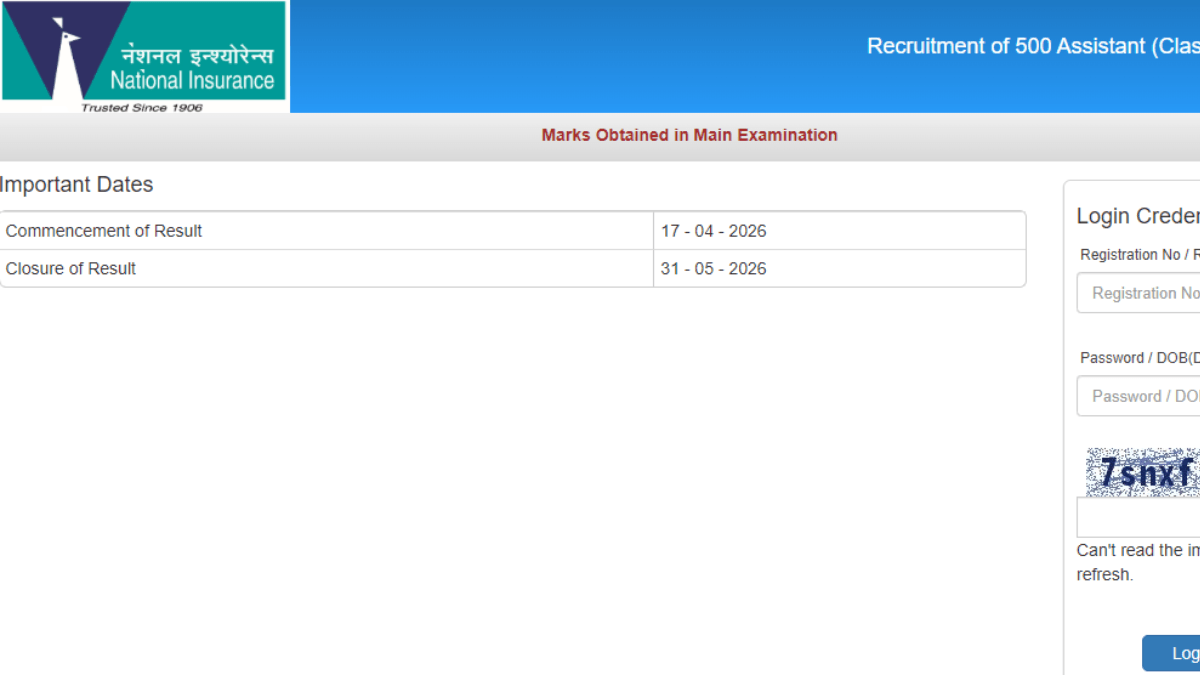
NICL Assistant Mains Score Card 2025 Out at nationalinsurance.nic.co.in, Download Link

The NICL Assistant Mains Score Card 2025 has been officially released on 27 April 2026 by National Insurance Company Limited on its official website. Candidates who appeared for the mains examination can now check their section-wise and overall marks by logging in with their credentials. The release of the scorecard comes after the completion of the recruitment process, allowing candidates to evaluate their performance in the mains exam.

NICL Assistant Mains Score Card 2025 Out

The NICL Assistant Mains scorecard is available online and includes detailed marks obtained by candidates in each section. It helps aspirants analyze their performance and compare it with the cut-off marks released by NICL. The scorecard can be accessed only through the official website and requires login credentials such as registration number and password.

NICL Assistant Mains Score Card 2025 Download Link

Candidates can download their scorecard from the official website of National Insurance Company Limited. The link is activated in the recruitment section, and candidates must log in to access their marks.

NICL Assistant Mains Score Card 2025: Click here to Download

Steps to Download Score Card

  • Visit the official NICL website
  • Go to the “Recruitment” or “Careers” section
  • Click on the “NICL Assistant Mains Score Card 2025” link
  • Enter registration number and password/date of birth
  • View and download the scorecard

Test Prime

Details Mentioned on NICL Assistant Score Card

The scorecard contains important information related to the candidate’s performance in the mains examination.

  • Candidate’s Name
  • Roll Number/Registration Number
  • Section-wise Marks
  • Overall Marks
  • Cut-off Marks
  • Qualifying Status

Importance of NICL Assistant Mains Score Card

The scorecard is not just a marksheet but a performance analysis tool for candidates. It provides clarity on strengths and weaknesses and helps in future exam preparation.

  • Helps evaluate exam performance
  • Useful for future exam strategy
  • Allows comparison with cut-off marks
  • Important for documentation and record

UPSC EPFO Notification 2026 To Be Announced Soon For 391 EO/AO and APFC Posts

UPSC EPFO Recruitment 2026 is expected to open doors for candidates aspiring to secure reputed central government positions. Nearly 391 vacancies for EO/AO and APFC roles are anticipated, and the recruitment process has moved forward with the Employees’ Provident Fund Organisation forwarding its proposal to UPSC, suggesting that the official notification may be released in the near future.

UPSC EPFO Notification 2026 To Be Announced Soon

As per the latest information obtained through RTI, the Employees’ Provident Fund Organisation has initiated the recruitment process by forwarding its proposal to UPSC. This development signals that the official notification stage is approaching and may be announced shortly. The news has generated considerable interest among aspirants preparing for secure and well-regarded government positions.

RTI Disclosure of UPSC EPFO 2026 Notification

The RTI reply dated 20 April 2026 has made the situation much clearer regarding the next recruitment cycle. Although exact exam dates cannot be officially predicted under RTI provisions, the confirmed internal steps taken by the Employees’ Provident Fund Organisation strongly indicate that the process is progressing quickly. With the proposal already in place with the UPSC, the release of the official notification now appears to be just around the corner.

Home_22.1

Expected Vacancy of UPSC EPFO Recruitment 2026

The UPSC EPFO Recruitment 2026 is expected to offer 391 vacancies, making it a major hiring drive for central government positions. These openings are split between EO/AO and APFC, both of which are key to handling administrative functions and ensuring the effective implementation of social security schemes.

Post Name Number of Vacancies
Enforcement Officer (EO) / Accounts Officer (AO) 311
Assistant Provident Fund Commissioner (APFC) 80
Total 391

Current Status of UPSC EPFO Notification 2026

According to the official document, the recruitment process for UPSC EPFO 2026 has already been set in motion. The Employees’ Provident Fund Organisation (EPFO) has formally sent a requisition to the Union Public Service Commission (UPSC) to initiate the hiring process for 391 vacancies across EO/AO and APFC posts.

Key Updates:

  • Requisition Sent: EPFO has officially requested UPSC to conduct the recruitment process for these 391 posts.
  • Next Step: UPSC will now examine the requisition, prepare the official notification, and publish the examination schedule on its official website (upsc.gov.in).

Expected UPSC EPFO Notification and Exam Timeline

Based on previous recruitment cycles and the timing of the requisition, experts have outlined a tentative schedule for the upcoming recruitment process:

  • Official Notification Release: Expected by August 2026
  • Recruitment Test (RT): Likely to be conducted in December 2026
  • Selection Process: A two-stage process consisting of a pen-and-paper Recruitment Test (RT) followed by a Personality Test (Interview)

Eligibility Criteria for UPSC EPFO 2026

Candidates aspiring to apply for UPSC EPFO Recruitment 2026 must fulfill the prescribed eligibility criteria in terms of educational qualification and age limit. While the detailed notification is awaited, the expected criteria based on previous cycles are as follows:

Educational Qualification

Applicants must possess a Bachelor’s degree in any discipline from a recognized university or institution. Additional qualifications such as a diploma in labour laws, public administration, or finance may be advantageous for certain roles.

Age Limit

  • EO/AO Posts: Maximum age limit is generally 30 years
  • APFC Posts: Maximum age limit is generally 35 years

Age Relaxation

Age relaxation is applicable as per government norms:

  • OBC: 3 years
  • SC/ST: 5 years
  • PwBD: 10 years
  • Additional relaxations may apply for other eligible categories as per UPSC rules.

Bank Mahapack Plus

Why UPSC EPFO is a Top Career Choice in 2026

The UPSC EPFO recruitment is gaining huge attention among aspirants in 2026 due to its strong career benefits and government job security. Conducted for roles under the Employees’ Provident Fund Organisation, it offers a perfect mix of stability, respect, and long-term growth.

Key Reasons to Choose UPSC EPFO:

  • Job Security: Permanent central government job with high stability
  • Attractive Salary: Good pay scale along with allowances and perks
  • Work-Life Balance: Better compared to many other government roles
  • Career Growth: Clear promotion path and long-term advancement
  • Prestigious Role: Opportunity to work in administrative and enforcement positions
  • Social Impact: Contribute to managing and implementing social security schemes

UPSC EPFO Selection Process

The selection process for UPSC EPFO Recruitment 2026 is expected to follow a two-stage structure, similar to previous recruitment cycles:

1. Recruitment Test (RT)

This is the first stage and is conducted in offline (pen-and-paper) mode. It is an objective-type exam designed to shortlist candidates for the next stage. The test generally covers subjects like:

  • General English
  • Indian Polity & Economy
  • General Accounting Principles
  • Industrial Relations & Labour Laws
  • General Science & Knowledge of Computer Applications
  • Current Events

2. Interview (Personality Test)

Candidates who clear the Recruitment Test are called for the interview round. This stage assesses:

  • Communication skills
  • Subject knowledge
  • Administrative aptitude
  • Overall personality

Final Selection

The final merit list is prepared based on the combined performance in both stages:

  • Recruitment Test: 75% weightage
  • Interview: 25% weightage

UPSC EPFO Salary

The salary for UPSC EPFO posts (EO/AO and APFC) is structured as per the 7th Pay Commission, offering a strong pay scale along with multiple allowances.

EO/AO Salary (Enforcement Officer / Accounts Officer)

  • Pay Level: Level 8
  • Basic Pay: ₹47,600 per month
  • Pay Scale: ₹47,600 – ₹1,51,100
  • In-hand Salary: Approx. ₹75,000 – ₹80,000 per month
  • Gross Salary: Around ₹85,000+ including allowances

APFC Salary (Assistant Provident Fund Commissioner)

  • Pay Level: Level 10
  • Basic Pay: ₹56,100 per month
  • Pay Scale: ₹56,100 – ₹1,77,500
  • Gross Salary: ₹1,00,000+ (approx., with allowances)
QR Code
Scan Me